Brand Naming: How to Land a Name That Survives the Trademark Check
A working designer's guide to brand naming. The six name types, the eight-filter gauntlet, and how to run a process that ends in a registrable name instead of a list of rejected favorites.
Naming is the most expensive part of branding to get wrong and the cheapest to postpone. Teams spend weeks on logos and hours on the word the logo wraps. The name survives a rebrand, a redesign, a founder change, and three product pivots. Everything else is replaceable. The name is not.
This paper is the working designer's version. Six categories of name that actually work, an eight-filter gauntlet that every candidate has to pass, and a process that ends in a registrable name instead of a list of founder favorites. No generators, no random Latin roots, no "available dot-coms only," just a method that survives legal review.
What a brand name actually has to do
A brand name has three jobs. It identifies the company, it signals something about the brand's position, and it survives twenty years of context change. Miss any of the three and the name becomes a rebrand waiting to happen.
Identification means the name is pronounceable, memorable, and distinct enough that a stranger can find it after hearing it once. Signal means the name hints at the brand's territory without boxing it in. Survival means the name still fits when the company moves into new markets, new products, or new eras of its own story. The brand identity glossary covers where naming sits inside the full identity system.
The six categories of brand names
Every real brand name falls into one of six categories. A naming process that does not agree on the category up front wastes weeks arguing across incompatible options.
Category 1: Descriptive
Describes what the company does. Examples: General Motors, American Airlines, International Business Machines. Strengths: instant clarity, cheap marketing, easy SEO. Weaknesses: generic, hard to trademark, limits expansion. A descriptive name locks the brand into its current product. When the product changes, the name lies.
Descriptive names work for commodities, industries with high search intent, and brands where being the obvious choice beats being the distinctive one. They fail for ambitious brands that plan to move.
Category 2: Suggestive
Hints at a benefit or quality without stating it. Examples: Airbnb (air mattress plus bed and breakfast), Spotify (spot plus identify), Patagonia (wilderness, ruggedness). Strengths: memorable, trademarkable, flexible. Weaknesses: requires more marketing spend to explain, easy to overthink.
Suggestive is the sweet spot for most modern brands. The name gives the brand a starting idea and room to grow. This is where most good naming work lives.
Category 3: Invented or coined
A word created from scratch or fused from parts of other words. Examples: Kodak, Verizon, Xerox, Häagen-Dazs. Strengths: fully ownable, trademark-clean, global scale. Weaknesses: meaningless on day one, expensive to build awareness.
Invented names are the choice for brands that expect massive global scale and have the marketing budget to teach the world what the word means. They are the wrong choice for small brands, because the name arrives empty and stays empty without enough exposure.
Category 4: Abstract
Existing words used in a context disconnected from their meaning. Examples: Apple (computers), Amazon (books), Twitter (microblogging), Virgin (airlines). Strengths: distinctive, emotional, infinitely flexible. Weaknesses: high upfront marketing cost, requires brand-led storytelling.
Abstract names work when the founder has the conviction and the capital to teach the market a new association. They fail when the brand cannot commit enough airtime to overwrite the default meaning.
Category 5: Founder or place-based
The founder's name, a place name, or a cultural reference. Examples: Ford, Dyson, Patagonia, Hermès. Strengths: storied, authentic, hard to replicate. Weaknesses: ties brand equity to an individual or geography, complicates succession.
Founder names carry the trust of the founder. They also carry the risk of the founder. If the founder leaves badly, the name either stays and suffers or changes at enormous cost.
Category 6: Compound or portmanteau
Two words fused into one. Examples: Instagram (instant plus telegram), Pinterest (pin plus interest), Microsoft (microcomputer plus software). Strengths: evocative, trademarkable, good domain availability. Weaknesses: can feel dated quickly, hard to get right without sounding forced.
Compounds work when the two roots compress into something that sounds like one word. Compounds fail when the stitch is visible and the result reads as two marketing words duct-taped together. The brand strategy glossary covers how category choice feeds back into positioning.
The eight-filter gauntlet
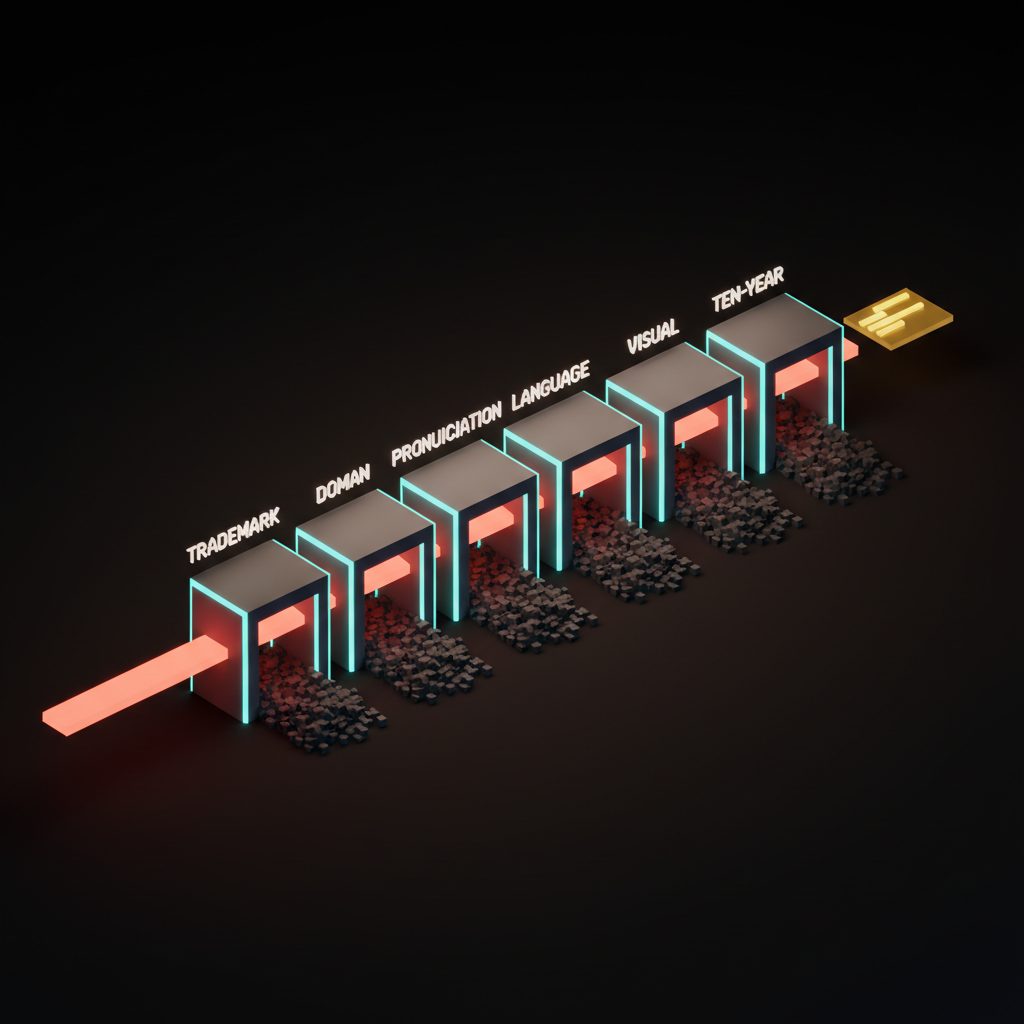
Every name candidate has to survive eight filters before it goes to a shortlist. Skip a filter and the name either dies in legal or gets rebranded inside five years.
Filter 1: Trademark availability
The single most important filter, and the one most naming processes run last. Check the name against the USPTO trademark database, the EU Intellectual Property Office, and at least one other major jurisdiction relevant to the brand's market. A name that is already trademarked in the same class is dead regardless of how good it sounds.
The common mistake is assuming "it is not an exact match" means "it is clear." Trademark law works on likelihood of confusion, not identical matching. A name one letter off from an established trademark in the same category is still blocked in most cases.
Filter 2: Domain availability
The .com is still the default, but the bar has dropped. A clean .com is ideal. A clean .co, .io, .ai, or a brand-appropriate TLD is acceptable. A misspelled .com (Flickr, Tumblr, Lyft) is a valid choice for some brands. A name whose .com is owned by a parked domain squatter demanding five-figure prices is a signal to reconsider unless the budget is already set.
Filter 3: Social handle availability
The brand needs a clean handle on Instagram, TikTok, LinkedIn, X, and whichever emerging platform matters for the brand's audience. Mixed availability (the brand on one, @brand_official on another) fragments brand equity over time. Check all five before falling in love with a name.
Filter 4: Pronunciation
Say the name to a stranger. Ask them to spell it back. Ask a second stranger to read it aloud from a written card. If the name survives both tests without a correction, it passes. If either fails, the name has a discoverability tax the marketing budget will pay forever.
International pronunciation matters for global brands. A name that is easy in English and offensive or unpronounceable in a major target market is a problem. Run the name past native speakers of the brand's top three non-English markets.
Filter 5: Linguistic clearance
The name cannot mean something embarrassing in the languages the brand expects to enter. This is not a one-time check for Mandarin, Spanish, and Portuguese. It is a full sweep across every market on the five-year roadmap, including slang and regional dialects.
Historical examples of the failure mode: Chevy Nova in Spanish-speaking markets ("no va" reads as "does not go" in some interpretations, arguably apocryphal but the lesson holds), Mitsubishi Pajero in Spain (slang for a self-pleasure reference, forcing a rename to Montero in Spanish markets). The brand system glossary covers how naming decisions cascade into global brand architecture.
Filter 6: Visual form
The name has to be set in type and evaluated as a mark. Some names read beautifully in sentence form and fall apart in a logomark. Long names with awkward letter pairings produce ugly logotypes. Names with double letters, unusual ascenders and descenders, or asymmetric silhouettes are harder to style into a mark.
The test is to set the candidate name in four different type categories (a serif, a sans-serif, a display type, and a geometric sans) at logo scale. If the name produces a workable mark in at least two, it is visually viable. If all four feel awkward, the name is a typography problem waiting to happen.
Filter 7: Search intent
Can a stranger Google the name and land on the brand? A name that collides with a common word, a famous person, or a long-established product is at a permanent SEO disadvantage. "Apple" survived because Apple the company had the resources to own the search result. A seed-stage brand does not.
Check the top ten search results for the exact name, both alone and paired with a category word. If the brand can realistically rank for at least one variation within the first year of existence, the name is searchable. If not, marketing will spend its life fighting ghost results.
Filter 8: Ten-year test
Read the name aloud and imagine it on a business card in 2036. Does it feel dated? Does it feel cute? Does it feel like it belongs to a different decade? The name should feel neutral across time, neither locked to its founding moment nor desperate to feel futuristic.
The ten-year test kills more candidate names than legal does. Names that feel clever in the founder's current era usually age badly. Names that feel slightly boring on day one often age well, because boring tends to mean "not specific to a trend."
The naming process
Skip the brainstorm-and-vote approach. Run a structured process in four phases instead.
Phase 1: Strategy before generation
Naming without a strategy is decoration. Before any name candidate gets proposed, the team agrees on the brand's positioning, target audience, personality, and territory. The brand strategy glossary covers the full input.
The critical outputs of this phase are a one-line brand definition, a personality descriptor (three to five adjectives), and a "territory" (the conceptual space the brand wants to own). Without these, Phase 2 devolves into a beauty contest where personal preference wins.
Phase 2: Generation by category
Work through all six name categories, not just the one the founder prefers. Generate twenty to fifty candidates per category. Most of them will be bad. That is the point. Volume is how the process finds the non-obvious winner.
Generation techniques worth running:
- Root-word mining from relevant domains (biology, geography, mythology, the product's industry language)
- Translation exercises (what does the brand's core idea sound like in seven languages)
- Phonetic play (alliteration, internal rhyme, rhythm)
- Abstraction tests (what other words share the brand's feeling but not its meaning)
A working pool at the end of Phase 2 is 100 to 300 candidates across all six categories.
Phase 3: The gauntlet
Run every candidate through the eight filters. Most die in the first three (trademark, domain, social). A shortlist of 10 to 20 names makes it to the visual and linguistic checks. A final shortlist of 3 to 5 names survives all eight filters.
This is the phase where naming processes usually break. Teams fall in love with a candidate in Phase 2 and refuse to kill it when it fails a filter in Phase 3. The filter is the point. A beloved name that fails trademark is not a name, it is a future legal bill.
Phase 4: Decision and registration
The final shortlist gets tested with the target audience, the team, and a conflict-of-interest stakeholder (a lawyer, a long-time brand advisor, someone who will say no without fear). The winner gets trademark registration filed the same week the decision is made.
Do not announce the name publicly before trademark registration is filed. Do not build a website on the name. Do not tell the audience. An announced-but-unregistered name is a name that competitors can still file on first in some jurisdictions.
How long naming should take
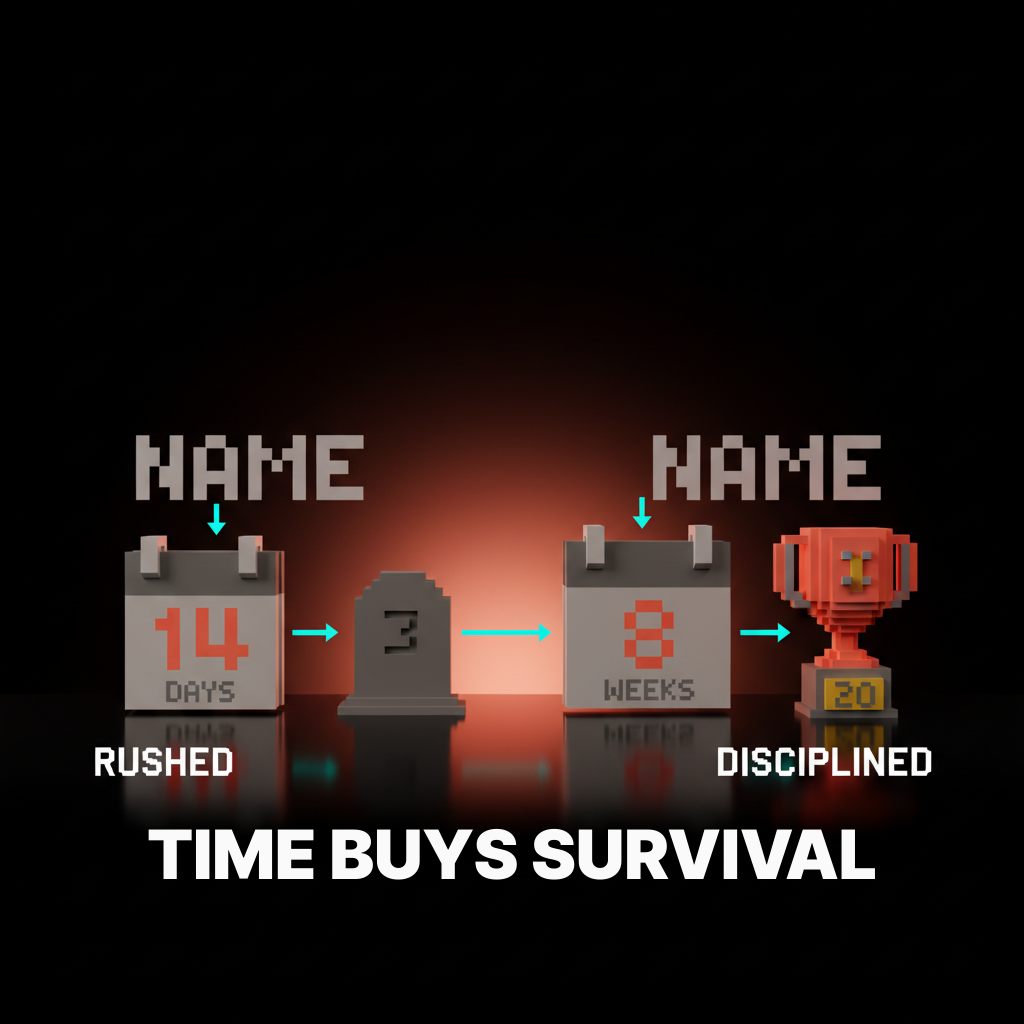
A full naming engagement for a funded brand runs six to twelve weeks. That includes strategy, generation, legal screening, decision, and registration. Anything faster than six weeks is skipping a filter. Anything slower than twelve weeks is a process problem, not a naming problem.
For a bootstrapped brand doing naming without a formal engagement, the same phases apply at smaller scale. Expect two to four weeks if the team is serious, six to eight if the founder is deciding alone.
Common naming failures
Three patterns account for most brand name problems.
The founder's favorite. The founder falls in love with a candidate early and refuses to kill it. The filter process becomes a theater designed to justify a decision already made. Six months later, the name fails in legal or in market. The fix is a naming committee of three to five people with equal veto power.
The committee compromise. Too many opinions in the room and every name gets vetoed by someone. The survivor is the name nobody hated, which is rarely the name anyone loves. The fix is a small decision-making body (three people, max), a strict timeline, and a willingness to accept disagreement on the final choice.
The trademark surprise. The name clears preliminary checks, the team falls in love, the launch is six weeks out, and the trademark search finds a blocking registration in month two. The fix is a comprehensive search at Phase 3, before any emotional investment builds up. A proper search costs money. Skipping it costs more.
The renaming loop. A brand launches with a name that fails one of the eight filters, limps along for three to five years, and eventually rebrands at enormous cost. Every major rebrand announcement that claims "we grew out of our old name" is a story about a name that failed Filter 8 and was not caught in time.
If you want a team that runs naming as part of a full brand identity process, from strategy to trademark to identity launch, hire Brainy. Naming is the most leveraged decision in branding. Run it like one.
FAQ
What makes a good brand name?
A good brand name identifies the company clearly, signals something about the brand's position without boxing it in, and survives twenty years of context change. It is pronounceable, distinctive, trademarkable, and visually workable as a mark. The name has to do three jobs at once: identify, signal, and survive.
How long does the brand naming process take?
A proper naming process for a funded brand runs six to twelve weeks across four phases: strategy, generation, filtering, and registration. Anything faster is skipping a step, usually legal screening or linguistic clearance. Bootstrapped processes can compress the timeline but not the rigor.
Should I trademark my brand name before launching?
Yes, always. Trademark registration has to be filed before any public announcement of the name. An announced but unregistered name can be filed on first by a competitor in some jurisdictions, and the cost of fighting for the registration afterward is far higher than the cost of filing early.
What if the .com for my name is taken?
Evaluate the alternatives. A clean .co, .io, or .ai is acceptable for many modern brands. A deliberately misspelled .com is valid if the misspelling is intentional and memorable (Flickr, Tumblr, Lyft). A name whose .com is owned by a squatter demanding five-figure prices is usually a signal to move on unless the budget is already allocated.
Should I use a brand name generator?
As an idea-starter only. Generators produce volume, not strategy. A generator cannot run an eight-filter gauntlet, does not know the brand's positioning, and usually surfaces candidates that are already trademarked. Use them to loosen up early-phase generation, never to make the decision.
How do I know if a name will age well?
Run the ten-year test. Imagine the name on a business card a decade from now. Does it feel locked to a trend, a technology, or a cultural moment? Neutral names age best. Names that feel clever in the founder's current era usually feel dated within five years. Boring on day one often ages into timeless.
Naming is leverage, not decoration
The name is the one brand decision that cannot be refactored. A logo can be redrawn, a palette can be retuned, a voice can be rewritten. The name either survives or the brand rebuilds itself around a different word. The leverage is enormous. The process that produces the name has to match.
Run strategy first. Generate across all six categories. Filter every candidate through all eight gates. Trademark before you announce. Name for the next twenty years, not the next six months.
If you want naming done as part of a complete brand identity system, hire Brainy. Strategy, naming, identity, and launch, one team, one decision path.
Related reading
- Brand Identity Guidelines
- How to Create a Brand Identity
- Brand Identity Vs Brand Image
- Logo Design Process
- Brand Identity Design Pricing
Need a name that clears trademark, owns a domain, and holds up in ten years? Brainy runs naming as part of full brand identity work, from territory to registration to launch.
Get StartedGet new papers by email
New Brainy papers in your inbox. Confirm once, unsubscribe anytime.