How to Price Brand Identity Design: A 2026 Pricing Guide for Designers
Real 2026 rate bands for logo, full identity, and brand systems across freelance, boutique, mid-tier, and top-tier studios, plus the value-based pricing framework agency founders actually use.
A client emails asking what a brand identity costs. The junior designer answers 3,000 dollars because they are scared. The senior designer answers 60,000 dollars because they have run the math. The client pays the senior designer, and not because the senior designer is ten times better. Because the senior designer knows how to quote a brand, and the junior designer knows how to quote a weekend.
Most designers underprice brand identity work by 40 to 70 percent, and the main reason is not skill. It is that nobody ever sat them down and walked through the real numbers. This paper is that sit-down. Actual 2026 rate bands across every market tier, the three ways studios structure pricing, the scope difference between logo work and a full system, and a worksheet Ron can hand to a designer on Monday morning to write a proposal that does not leak margin.
Why pricing breaks most design businesses
Brand identity is one of the highest-leverage services a designer can sell, and it is also the one most frequently quoted wrong. Logo design has a ceiling that the market recognizes. Brand identity does not, because it directly shapes how a business sells for the next five years. That asymmetry is either the designer's biggest leverage or their biggest leak.
Three pricing mistakes make up most of the damage. Designers quote hourly on creative work, so the client buys hours instead of buying an outcome. Designers quote a single number, so the client cannot see what they are getting in tiers. Designers quote before they understand what the brand is for, so the number is a guess and the client negotiates it down because a guess sounds negotiable.
Fix these three and the same designer, with the same craft, charges two to four times more on the next project. That is not a motivation quote. That is what the math does.
The 2026 rate bands, by market tier
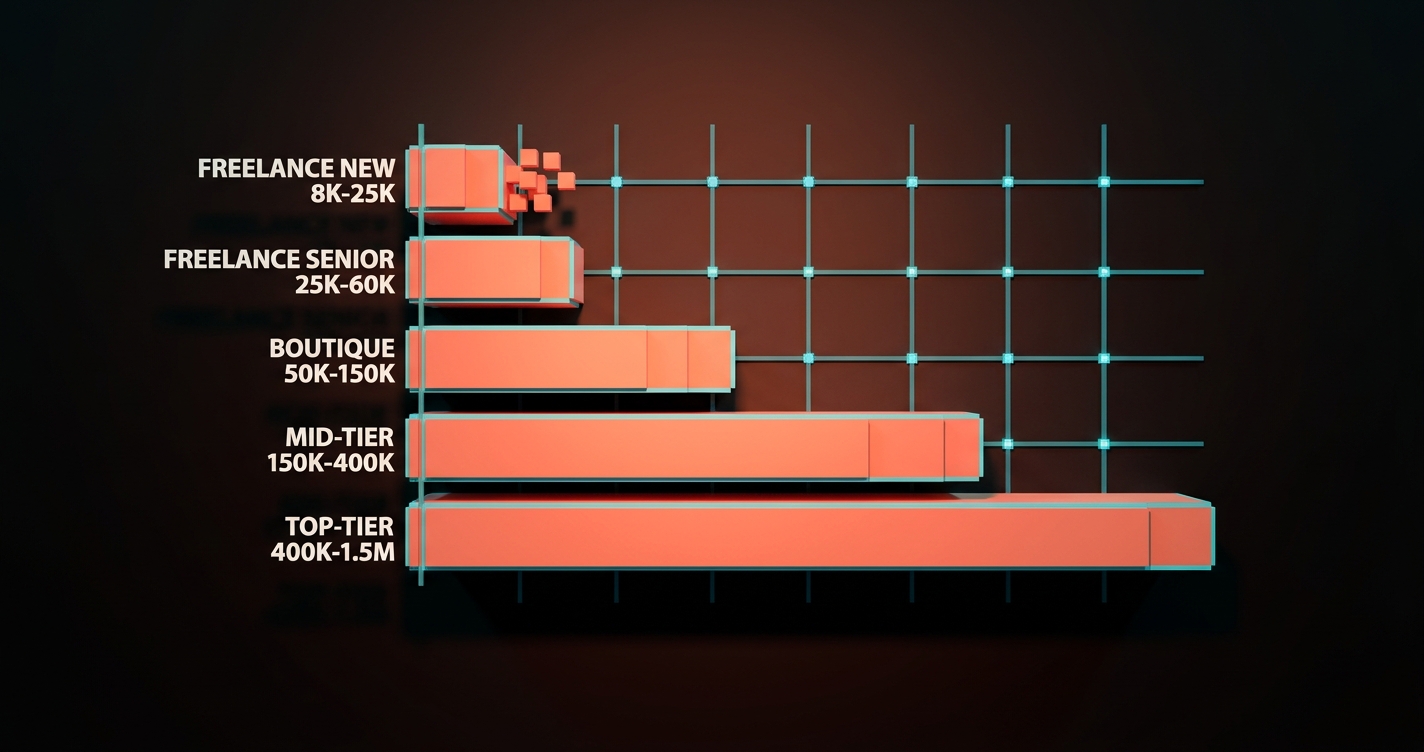
Here are the real numbers. These are ranges, because the top of each band assumes a senior designer or studio with a portfolio and a track record. The bottom assumes competent work with less pricing leverage. Nothing here is "it depends." It depends within these ranges, not outside them.
| Market tier | Logo only | Full brand identity | Brand system (identity + guidelines + rollout) |
|---|---|---|---|
| Freelance (new to mid) | 2,000 to 6,000 | 8,000 to 25,000 | 25,000 to 50,000 |
| Freelance (senior) | 6,000 to 15,000 | 25,000 to 60,000 | 50,000 to 120,000 |
| Boutique studio (2-8 people) | 15,000 to 35,000 | 50,000 to 150,000 | 120,000 to 300,000 |
| Mid-tier studio (10-40 people) | 35,000 to 80,000 | 150,000 to 400,000 | 300,000 to 800,000 |
| Top-tier studio (Pentagram, Collins, Wolff Olins) | 80,000 to 250,000 | 400,000 to 1.5M | 1M to 5M+ |
These are 2026 US dollar figures for mid-market clients (seed to series B, established SMBs, mid-market retailers). Enterprise and regulated industries scale up another 2 to 5x. Early-stage pre-revenue clients often sit at 50 to 70 percent of the freelance bands. Geography matters too: European studios index slightly below US rates, and top Asian studios (Tokyo, Shanghai, Seoul) now match or exceed US rates at the top tier.
Market reasoning behind these numbers. Brand identity pricing follows the buyer, not the craft. A series-B SaaS company spending 80,000 dollars on a brand is spending 0.2% of a 40M raise. That company does not care whether you are a solo freelancer or a boutique. It cares whether the brand system will survive their next 18 months of scaling. A 2,000-dollar DIY logo builder cannot deliver that. A 6,000-dollar freelancer can deliver a logo but probably not a system. A 50,000-dollar boutique can deliver the full system with room to iterate. The price point matches the risk the buyer is hedging.
What you actually sell: three scopes
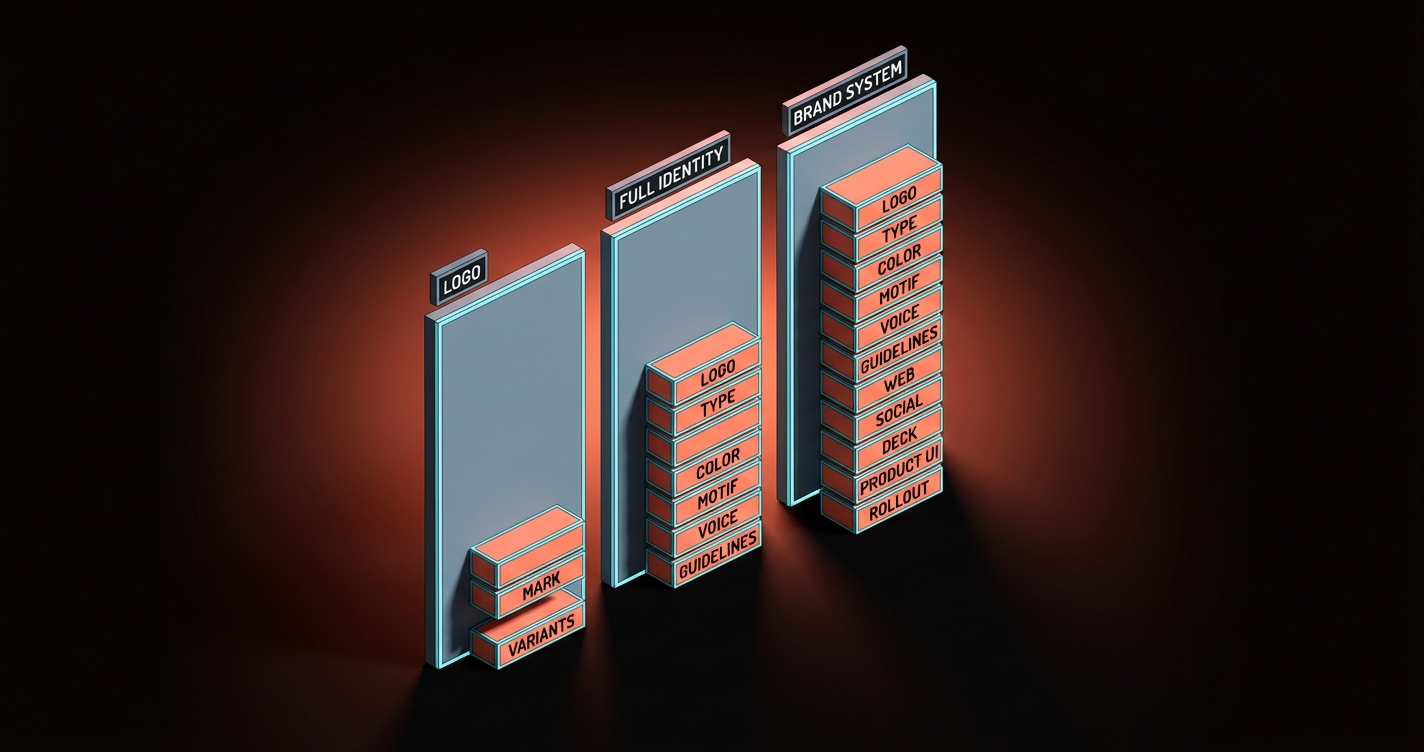
The biggest single cause of underpricing is quoting a "brand identity" without defining which of the three scopes you are actually delivering. These are three different products. Treating them as one is why clients expect a full system for logo money.
Scope 1: Logo only
The deliverable is a mark. Wordmark, or wordmark plus symbol, with variants (horizontal, vertical, mark-only, monochrome), color tokens, and a short usage sheet. Typography is referenced, not designed. Color is defined at the logo level, not as a system palette. There is no motif, no voice, no application work.
This is the right scope when the client has everything else defined and only needs the mark. It is rarely the right scope when they tell you they need "a brand," but many freelancers deliver this and call it a brand identity. Price this at the logo-only column above, not at the full-identity column.
For the complete craft-level walkthrough of logo work inside this scope, see the logo design process.
Scope 2: Full brand identity
The deliverable is a coherent identity system. Logo system, typography (primary plus body, licensed or explicitly specified), color palette (brand color, secondaries, neutrals, semantic), motif (the non-logo recurring visual), verbal identity (voice, vocabulary, tone examples), and a mid-sized guidelines document (15 to 40 pages). Application examples are included: website hero, social avatar and template, business card or digital equivalent, presentation title slide, email signature.
This is the scope that most mid-market clients actually need. The how to create a brand identity pillar covers the seven-phase process that produces exactly this scope. Price this at the full-identity column.
Scope 3: Brand system (identity + guidelines + rollout)
The deliverable is the identity plus the infrastructure to operate it. Full guidelines document (30 to 80 pages or a hosted brand site at brand.company.com), asset library (social templates, presentation templates, product UI kit, packaging templates if relevant), governance rules (who approves what, brand owner role definition), and a supervised rollout over 4 to 12 weeks after launch.
This is the scope that companies buy when they are betting the business on the brand. Series-B and later, enterprise rebrands, category-defining product launches. Price this at the brand-system column, and never sell it for less. Underpricing rollout is how designers end up doing 80 hours of unpaid work in month four of a project that should have already shipped.
The three pricing models and when to use each
There are only three ways to structure the number on the proposal. Every variant is one of these wearing a costume.
Hourly (do not do this on creative work)
Hourly billing maps time to money. It makes sense for work with a knowable time cost: production passes, motion revisions, QA, retainer-based design-ops. It does not make sense for brand identity because brand identity value is not proportional to hours. A great wordmark that closes series-B funding in three weeks is worth more than a mediocre wordmark that took six months.
The second problem with hourly is that clients feel every hour. They will ask why step three took longer than you estimated. They will question revisions. They will push back on the sketching phase. You end up defending your process instead of doing the work. Most designers who switch away from hourly report 30 to 50 percent margin lift on the same projects.
Hourly is still the right model for a small set of cases: retainer work with open scope, production-heavy phases (motion, asset expansion, translation), and consulting or advisory time. Put those on hourly and put everything else on fixed scope.
Package pricing
Package pricing quotes three fixed options (usually good/better/best or bronze/silver/gold, though do not literally name them that) with clearly differentiated scope. The client picks one. You deliver exactly what is in the chosen package.
This model works because it reframes the conversation. The client is no longer asking "can you do this for less." The client is asking "which package fits." Package pricing typically recovers 20 to 40 percent more revenue than single-quote pricing on the same average project, because roughly 30 percent of clients choose the middle option and 10 to 20 percent choose the top.
Use package pricing for most brand identity work aimed at SMB, early-stage startup, and mid-market clients. It is fast to produce, easy to present, and forces scope clarity.
Value-based pricing
Value-based pricing sets the fee as a function of the outcome the client gets, not the cost of producing the work. If the brand identity will enable a 5M funding round, a 500K fee is 10% of the enabled value and cheap. If the same brand will be used by a 50K-revenue side business, a 25K fee is 50% of annual revenue and absurd. Same craft, different price, different client.
Value-based is the model top studios use because it aligns the fee with the client's upside. The conversation in the sales call is about outcomes (funding readiness, category positioning, growth enablement, rebrand risk reduction) instead of deliverables. The deliverables are still defined in the contract, but they are not what the number is priced against.
Use value-based on your top 20 percent of clients: senior founders, series-B+ companies, mature SMBs, enterprise engagements. Run package pricing on the rest. Value-based requires a sales conversation the client is willing to have, which usually means an inbound warm lead, not a cold brief.
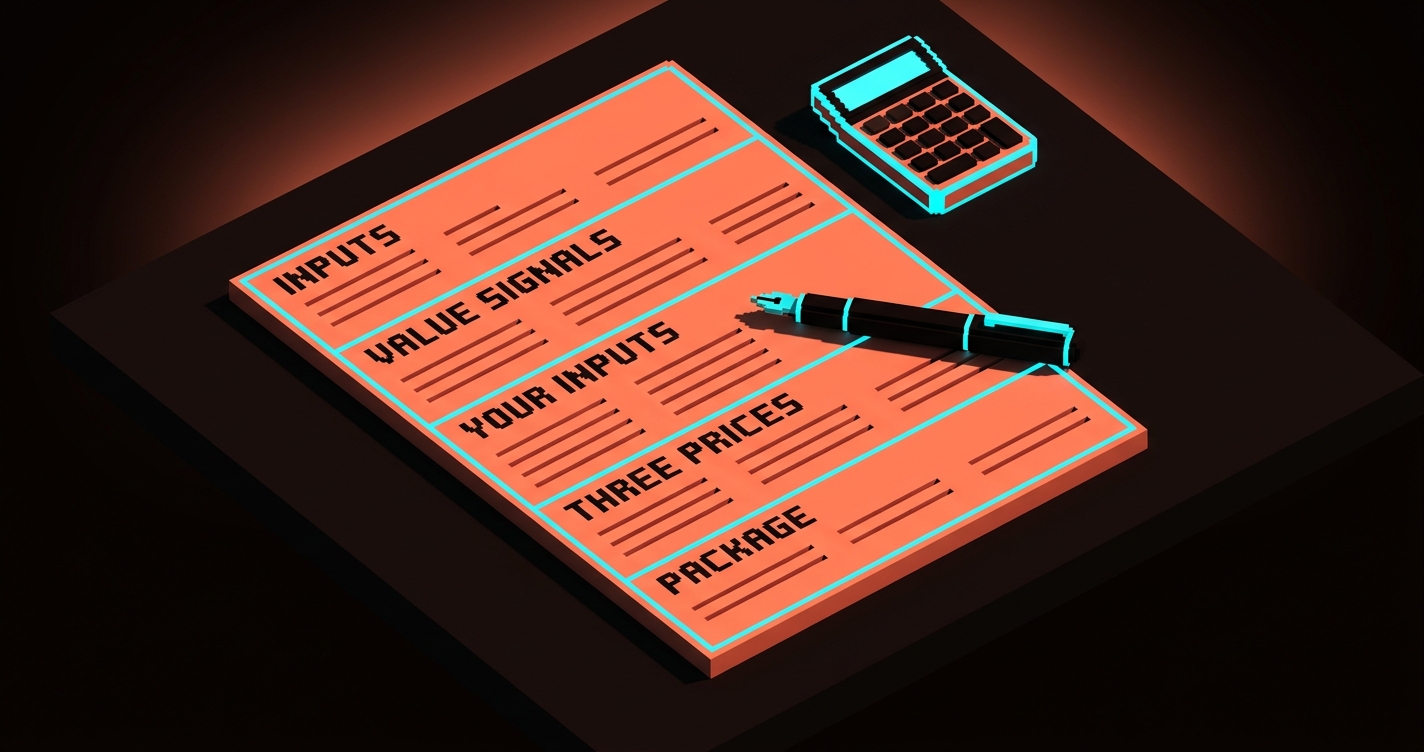
The pricing worksheet (ship this into BrandBrainy)
Here is a single-page worksheet for pricing a brand identity engagement. Fill it in before the proposal is written. The output is your quote floor, your quote target, and your walk-away.
Section 1: Project inputs
- Client stage (pre-revenue, seed, series A, series B+, mature SMB, enterprise)
- Industry (commodity, default, premium, regulated, category-defining)
- Timeline pressure (relaxed 12+ weeks, normal 8-12 weeks, tight 4-8 weeks, crash under 4 weeks)
- Scope selected (logo only, full identity, brand system)
- Application count (number of surfaces: web, social, product UI, packaging, signage, etc.)
Section 2: Value signals
- What outcome is this brand enabling? (funding round, product launch, rebrand, category repositioning, rollup)
- What is the downside of the brand failing? (credibility loss, missed raise, category confusion, churn)
- What is the approximate dollar value of the outcome? (best estimate, even a rough range)
- How many people in the client org will depend on the brand system weekly?
Section 3: Your inputs
- Your tier (freelance-new, freelance-senior, boutique, mid-tier)
- Hours estimate for the scope (low, mid, high)
- Your blended rate (what you would charge hourly if you had to, for your own math only, never the client's)
- Revision rounds included (2 is standard, 3 for complex scopes, never unlimited)
Section 4: The three prices
Your quote floor is: your hours estimate at your blended rate, multiplied by 1.5 (buffer for revisions and scope drift). Never quote below this.
Your quote target is: the corresponding range from the rate band table above, adjusted for the value signals (shift toward the top of the range for strong value signals, the middle for normal, the bottom only when client stage is genuinely early).
Your walk-away is: your quote floor minus 10 percent. If the client pushes below this, you do not take the project. You decline politely and suggest they work at a scope that matches their budget. Taking work below walk-away costs you the project you would have landed instead.
Section 5: Package the price
Turn the single target price into three package tiers by scoping up and down. Example for a target of 60,000 dollars:
| Tier | Price | Scope |
|---|---|---|
| Tier 1 | 35,000 | Logo system + typography + color, basic guidelines (15 pages), 2 application examples |
| Tier 2 (target) | 60,000 | Full identity: logo + type + color + motif + voice, mid guidelines (30 pages), 6 applications, 3 revision rounds |
| Tier 3 | 110,000 | Tier 2 plus full rollout (social templates, web hero, presentation kit, product UI kit, supervised 60-day launch) |
Most clients pick tier 2. Some pick tier 3 once they see it framed. The tier 1 exists mostly to make tier 2 look reasonable. Never quote a single price when a package structure is available.
How to present pricing without discounting
The proposal is not where the price lands. The sales conversation is. If the proposal is the first time the client sees a number, you lost.
Three moves that hold the price through the negotiation.
Anchor high first, then present the middle. When a client asks what a brand identity costs, start with the top tier ("our full systems run 120 to 300 thousand") before introducing the middle and entry tiers. This sets the anchor. The middle tier then lands as reasonable. Starting low and trying to upsell is a losing pattern because the client's number in their head is the first one they heard.
Sell the scope, not the price. When a client pushes back on the number, never respond with price. Respond with scope. "We can run at 40,000 instead of 60,000, and here is what comes out: no motif, no guidelines document, two applications instead of six." The client now chooses between the price and the scope. Nine out of ten times, they choose the scope and the price comes back.
Treat discounts as precedent, not favors. Every discount you give sets the expectation for the next project. A 20 percent first-project discount means the client's renewal comes in at the discounted rate too, and they tell two founder friends about how your pricing works. If you have to give a discount, trade it for something: a case study publication right, an introduction to three other founders, a quarterly retainer, a longer timeline that lets you slot the project into a lower-demand window. Never discount for free.
The designers who hold pricing best are usually not the most skilled. They are the ones who run this playbook reliably.
Anti-patterns that leak margin
Five pricing mistakes that cost designers real money, in rough order of how much damage each does.
Hourly billing on creative work. Already covered above. The single biggest margin leak in the industry. Every top studio bills fixed or value-based on brand work.
Unlimited revisions. Three letters you do not want in a contract: "etc." Revisions must be counted (2 is normal, 3 for complex scopes), and anything beyond is a change order at a separately agreed rate. Designers who offer unlimited revisions spend 30 to 50 percent of project hours in revision loops and make 40 percent less per project.
Scope creep without change orders. "Can you also do the packaging?" said mid-project is not a polite add. It is a scope change that needs a change order, a new line item, and a new price. Designers who absorb this as "being easy to work with" are trading their margin for the client's comfort.
Discounting under pressure. Already covered. The pattern is: client pushes back on price, designer panics, designer cuts 20 percent to "make it work." The client now expects that rate forever, tells other clients about it, and the designer has just created a lower price ceiling for themselves.
Quoting before understanding. Quoting in the first call, before you have done discovery, is how designers end up underpricing 60 to 80 percent of the time. The five questions from the discovery framework in how to create a brand identity take 30 minutes and change the quote by 2 to 3x. Quote after discovery, never before.
What to charge your current client
A rough decision tree to use on the next proposal you write.
- Is the client pre-revenue or seed, with tight runway? Quote the freelance-new range, in packages, with a tier 1 that matches their likely budget. Do not stretch below the floor.
- Is the client at seed to series A with normal budgets? Quote the freelance-senior or boutique range, in packages, with tier 2 as your target.
- Is the client at series B or later, or an established SMB with a real marketing budget? Quote the boutique or mid-tier range, with value-based conversation if you have the inbound signal for it.
- Is the client enterprise or regulated? Quote the mid-tier or top-tier range, value-based, with a full proposal process including a scoping workshop billed separately.
- Is the client a friend, a referral, or pressure-applying in any way? Quote slightly higher than the above decision, not lower. Friends and referrals are not a discount signal. They are a trust signal, which means they are the least likely to push back on price.
The color decisions in the brand system itself are downstream of the pricing conversation. The brand color palette guide covers the craft work once the scope is defined. The brand identity examples post covers how finished systems look across real companies, which is useful reference for clients who have not seen comparable work.
FAQ
How much does a brand identity cost in 2026?
For a full brand identity (logo, typography, color, motif, voice, guidelines, application examples), expect 8,000 to 25,000 from a new-to-mid freelancer, 25,000 to 60,000 from a senior freelancer, 50,000 to 150,000 from a boutique studio, 150,000 to 400,000 from a mid-tier studio, and 400,000 to 1.5 million from a top-tier studio like Pentagram or Collins. Logo-only work runs 20 to 40 percent of those numbers. Full brand systems with rollout run 2 to 4x. The right number depends on the client's stage, industry, and the outcome the brand is enabling, not on the craft alone.
Should I charge flat rate or hourly for brand identity?
Flat rate, packaged in three tiers, for almost all brand identity work. Hourly is the wrong model for creative work because the value is not proportional to time spent. Clients buy outcomes, not hours. Reserve hourly for retainers, production passes, and advisory time. Designers who switch away from hourly on brand work report 30 to 50 percent margin lift on the same projects.
What affects brand identity pricing the most?
Four factors, in order of impact. Client stage and industry (series-B SaaS pays 5x what pre-revenue pays). Scope (logo only vs full identity vs full system with rollout). Your tier and portfolio (freelance vs boutique vs top studio). Timeline pressure (a 4-week crash project is worth 50 to 100 percent more than the same scope on a 12-week timeline). Craft matters within a tier but does not cross tiers on its own: a senior freelancer with brilliant craft still caps near boutique pricing unless they package and sell like a boutique.
Price the outcome, not the hours
The designers who build real businesses on brand identity work are not the most talented ones. They are the ones who learned to price the outcome instead of the hours, to quote in packages instead of single numbers, to quote after discovery instead of before, and to hold the number when the client pushes back.
Run the rate bands. Pick the scope honestly. Structure the price in three tiers. Write the proposal after discovery, never before. Hold the walk-away. Trade discounts for precedent value when you give them.
A brand identity is worth what it enables the business to do, which is almost always more than the designer would have guessed. The designers who recognize this first are the ones running studios. The designers who do not are the ones billing hourly and wondering why every project feels like a loss.
Price the outcome, not the hours. Ship the scope, not the shape. The proposal is a design artifact. Treat it like one.
Building a brand identity and need a studio that prices work without hiding behind "it depends"? Brainy ships brand systems end-to-end at fixed, scoped rates.
Get StartedGet new papers by email
New Brainy papers in your inbox. Confirm once, unsubscribe anytime.