
Brand Identity vs Brand Image: What Designers Need to Know
The real difference between brand identity, image, and reputation, and how to tell which layer is broken when your business signals go bad.
Every article on this topic gives you the same vocabulary quiz. Identity is what you project. Image is what they perceive. Done. Congratulations, you now know the definition of a word.
That framing is technically true and operationally useless. Designers already know the definition. What they need is the thing nobody writes about: which layer to fix when something is broken. Low conversion, weak recall, price resistance, rebrand backlash. Each of those points at a different layer. Fixing the wrong layer is the most expensive mistake a brand team can make, and most of them make it.
Here is the version that actually changes how you work.
The textbook definitions, fast
Brand identity is the system a business designs to be recognized. Logo, color, typography, voice, visual system, guidelines. It lives in a file. You can print it, share it, hand it to a vendor.
Brand image is the perception that lives in the audience's head right now. It is what a person thinks, feels, and associates when they see the brand. It is shaped by the identity, but also by the product, the service, the ad they saw last week, and the one bad review that stuck.
Those two sentences are the full vocabulary quiz. Keep reading. The definitions are the least interesting part of this.
Identity, image, reputation: the three-layer model
Most of this topic gets flattened into two boxes. That is why most of the writing on it is thin. There are actually three layers, and they operate on different timescales.
Identity is designed. It is deliberate, controlled, documented. A designer and a strategy team produce it. Output: a real brand identity system, captured as brand guidelines, expressed through visual identity and voice rules.
Image is perceived. It is what a single person currently thinks of the brand after their last exposure. It shifts per person, per week, per campaign.
Reputation is aggregated. It is the running average of brand image across many people over many years. It is sticky, slow to build, slow to change, and it eats into brand equity for better or worse.
Identity is a file. Image is a snapshot. Reputation is a trend line.

Side-by-side, the only table you need
If you remember one thing from this article, remember this table. It is the difference between confident triage and expensive guesswork.
| Identity | Image | Reputation | |
|---|---|---|---|
| What it is | A designed system | A current perception | An aggregated trend |
| Who owns it | Design and strategy team | The audience, one person at a time | The market, over years |
| How fast it moves | Days to months (a rebrand) | Hours to weeks (a campaign or incident) | Years (compounded delivery) |
| How to fix it | Redesign the system | Change the touchpoints and messaging | Deliver on the promise, consistently, for a long time |
| Primary tool | Design | Marketing and product | Operations and product |
| Cost profile | High upfront, low ongoing | Medium, continuous | Low per action, high over time |
Notice the bottom row. Identity is the cheapest layer to fix because it is fully in your control. Reputation is the most expensive because you cannot buy it, you can only earn it. This is also why most struggling brands reach for a rebrand. It feels like action. Often it is the wrong action.
Where identity and image drift apart
A clean identity does not guarantee a good image. The gap between the two is where most brand problems live. Three patterns come up constantly.
The rebrand backlash. The identity updates, the audience has not caught up. The perceived image lags the designed identity by months. Gap Inc. 2010. Tropicana. Twitter to X. The identity on paper said "modern, bold, new." The image in the audience's head said "what did they do to my brand." The identity was not wrong in isolation. It was too far from the current image for the transition to land.
The trendy-looking fintech problem. The identity nails a clean, serious, modern aesthetic. The product is buggy, support is thin, and users feel burned. The image says "untrustworthy" no matter what the identity does. You cannot design your way out of that.
The premium positioning mismatch. The identity says luxury. The website is slow, the checkout is broken, the copy is generic. Image says "pretending." Gap between layers becomes the brand's actual message.
You cannot rebrand your way out of a product problem.
The diagnostic: which layer is actually broken
When a business signal goes bad, most teams blame the nearest layer they know how to change. Usually that is the identity, because it is the most visible. That is backwards. Diagnose first, then act.
Run the signal through this tree.
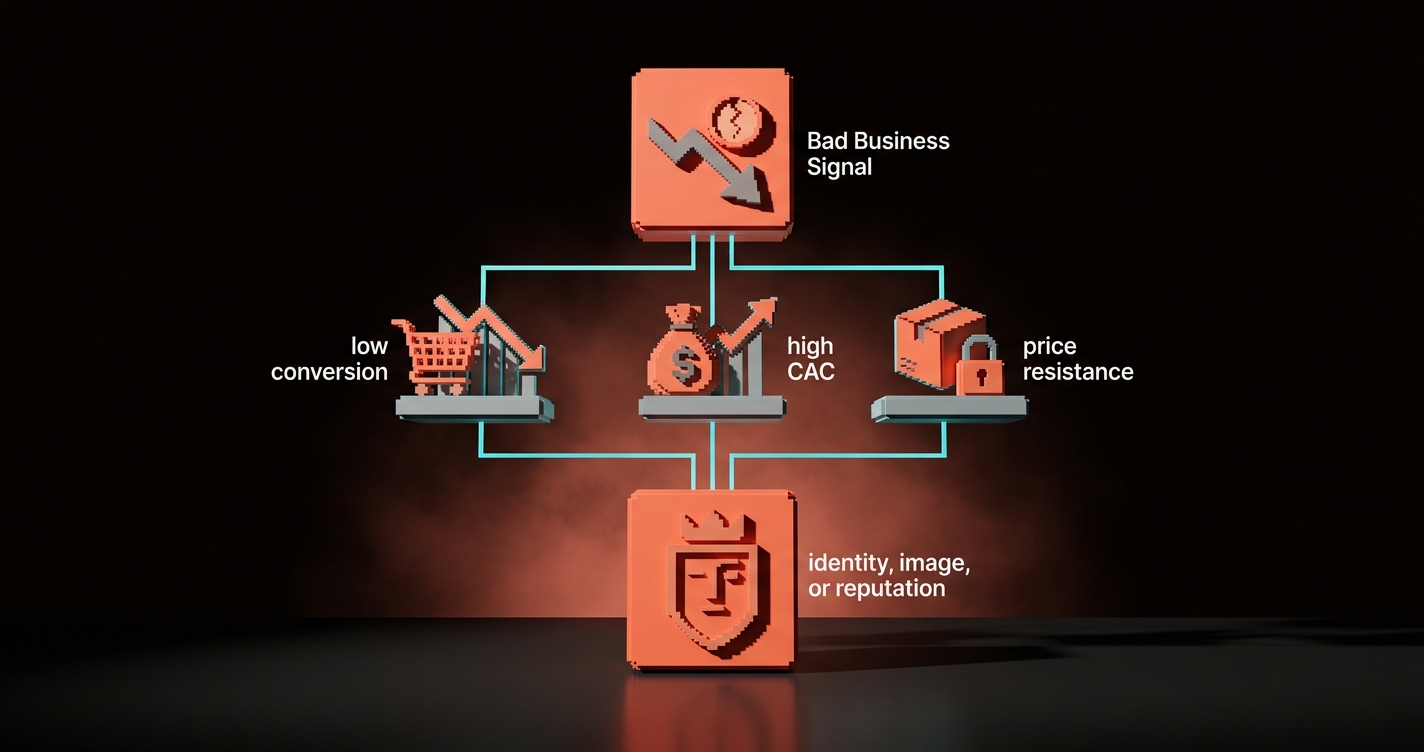
Signal: Low brand recall in market research. People forget the brand. This is an identity problem. The visual system is not distinctive enough to stick. Fix the identity. Audit logo, color, type, and distinctive assets.
Signal: Low conversion on a working product. People visit, do not buy, product is fine. This is an image problem at the touchpoint. The website, the positioning, the hero copy, or the visual polish is off-key. Fix the touchpoints, not the logo.
Signal: High customer acquisition cost that keeps rising. Each paid click costs more to convert. This is usually an image or reputation problem. The audience has seen you and formed a perception that does not match the offer. New identity will not cut it. The message and proof have to change.
Signal: Price resistance from qualified buyers. They want the product, they think you are too expensive. This is almost always reputation. You have not earned the price bracket in the market's eyes yet. Fix it by delivering consistently at that level, collecting social proof, and raising the evidence floor.
Signal: Churn after a good first impression. The identity and image are set correctly, the product does not deliver. This is not a brand problem at all. It is a product problem wearing a brand disguise. Fix the product.
The useful move is almost never the first one people reach for.
What designers control, what they do not
This part matters because it sets your scope honestly. Pretending you control reputation is how brand designers get blamed for business problems they did not cause.
Identity: fully yours. The designer and the strategy team hold the pen. Every pixel, rule, token, and voice choice is in your control. If identity is broken, it is on the team that built it.
Image: mostly yours, with caveats. The designer controls touchpoint quality, consistency, and visual execution. Marketing controls campaign messaging. Product controls what happens after the click. You can get the identity and the touchpoints right and still watch the image sink because the product let users down. The brand voice is the lever you do control directly across surfaces.
Reputation: barely yours. Reputation is the residue of what the business delivers, aggregated across everyone who has ever encountered it. Operations, product, support, and leadership own most of it. Design supports by keeping the identity stable enough that the reputation has something consistent to attach to.
If you want to see this split in action, look at how real companies stitch the three layers together. The teardowns in our brand identity examples show identity doing its job. Image and reputation live in the business results, not the style guide.
How to audit each layer separately
Treat this as a checklist. Run it on a brand that is struggling, and you will know within an hour which layer needs work.
- Logo, color, and type usage consistent across the last ten touchpoints?
- Distinctive assets that would be recognizable without the logo?
- Guidelines that a third-party vendor can follow without a call?
- Voice rules that produce the same tone from two different writers?
Image audit
- What do five real customers say the brand stands for, in one sentence each?
- Do those sentences match the identity's stated positioning?
- What do non-customers say after seeing the homepage for ten seconds?
- Where does perceived quality break (site speed, copy, checkout, onboarding)?
Reputation audit
- Search the brand name and read the first two pages. What story emerges?
- Review score trend across the last 24 months. Direction matters more than absolute.
- Referral rate and repeat purchase rate. Reputation moves these before surveys catch it.
- What do employees and former employees say? Reputation leaks out of payroll.
Any gap between what the identity claims and what the audit surfaces is the work. Close the gap, do not re-argue the identity.
FAQ
What is the simplest way to explain brand identity vs brand image?
Identity is what the business builds. Image is what a person currently thinks. The business controls the first. The audience controls the second. Reputation is what happens when you add up the second across many people and many years.
Can you change brand image without changing brand identity?
Yes, and it is often the right move. Image shifts through touchpoint quality, messaging, and product experience. If the identity is sound, changing the image means fixing what the audience sees and feels around the identity, not the identity itself.
How long does it take to change brand reputation?
Years. Reputation is the slowest layer because it is cumulative. A single campaign will not move it. A consistent improvement in what you deliver, sustained over two to five years, will. Shortcuts are mostly illusions.
Is brand perception the same as brand image?
Close enough for most conversations. Brand perception is a slightly broader term that sometimes includes reputation. Brand image is the snapshot version: what someone perceives right now, after their latest exposure. When in doubt, use image for the snapshot and reputation for the aggregate.
The short version
Identity, image, and reputation are three layers, not synonyms. Identity is a file you build. Image is a snapshot the audience carries. Reputation is a trend line the market aggregates. Each moves on a different timescale. Each breaks for different reasons. Each responds to a different fix.
Next time a business signal goes bad, run the diagnostic before you reach for a rebrand. Low recall is identity. Low conversion is image. Price resistance is reputation. Churn after good first impressions is the product, not the brand.
Most brand problems are diagnosed badly and fixed expensively. The teams that do this well know which layer they are fixing before they sign off on the scope.
Brand identity drifting from brand image? Brainy builds brand identity systems that survive contact with real customers, real campaigns, and real reputation over time.
Brand identity drifting from brand image? Brainy builds identity systems that survive contact with real customers.
Get StartedGet new papers by email
New Brainy papers in your inbox. Confirm once, unsubscribe anytime.