
Brand Identity Guidelines: What Every Brand Book Needs in 2026
The 2026 brand book is not a PDF of logo rules. It is a living system AI tools, automated pipelines, and distributed teams can actually use. Here is what it needs.
Open any "brand guidelines" article from the last five years and you get the same table of contents. Logo usage. Clear space. Color palette with hex values. Primary and secondary fonts. A tone of voice paragraph that says "friendly but professional." Save as PDF. Upload to Google Drive. Forget about it.
That brand book is dead. It died quietly, right around the time your marketing team started drafting copy in ChatGPT, your designers started pulling tokens into Figma variables, and your social team started shipping eight aspect ratios of every post. The humans reading your brand book are now outnumbered by the machines reading it, and almost none of those machines can parse a PDF.
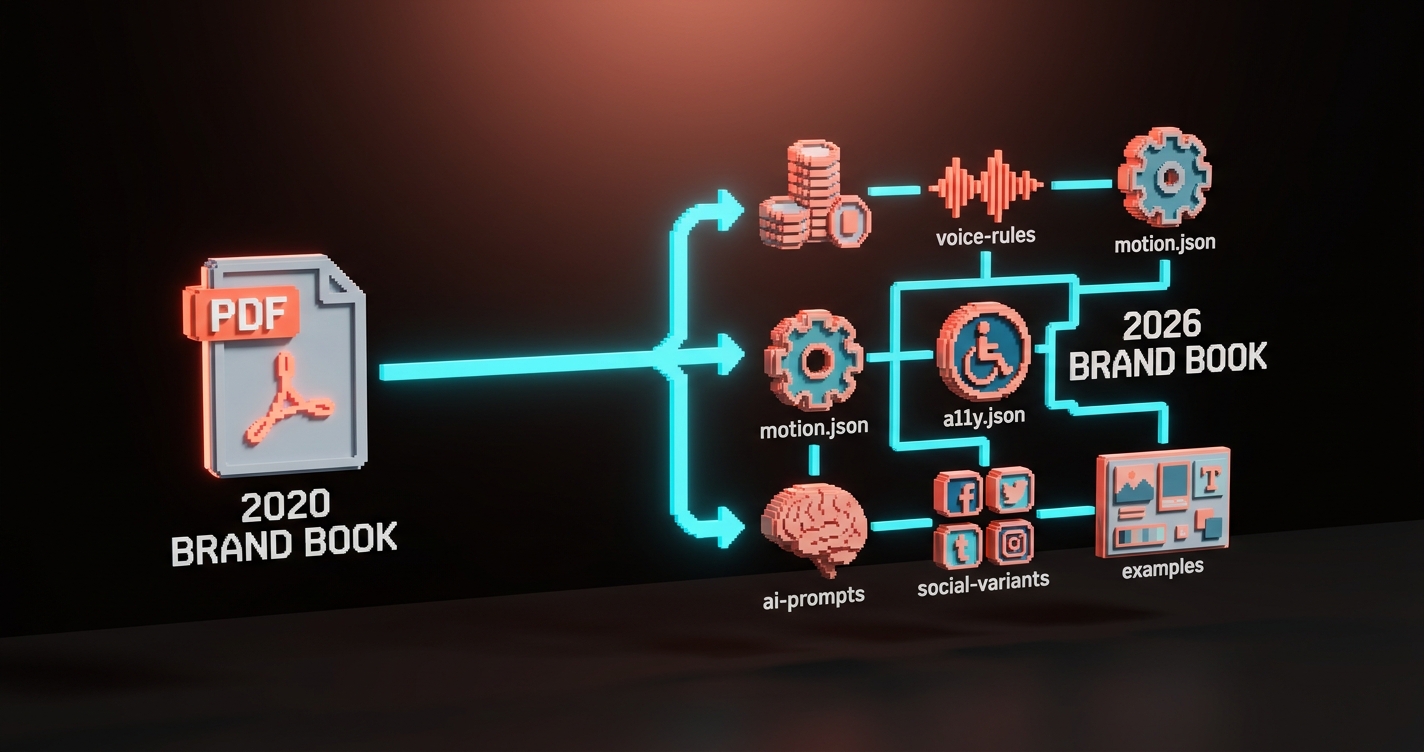
A 2026 brand book has to feed design tokens to Figma, voice rules to an LLM, motion specs to After Effects, and accessibility baselines to a CI pipeline, all while still making sense to the junior designer who joined last week. That is a different artifact. Let's go through what it actually needs.
The old brand book is dead
The 2020 brand book was a static PDF that a designer made once, every five years, when a CEO got bored with the old one. It sat on a shared drive nobody remembered the link to. When the team had a question, they guessed. When a vendor had a question, they invented.
That worked when the only people producing brand assets were a small in-house design team. It stopped working the minute production went distributed and automated.
Now, brand output comes from freelancers in four time zones, a marketing team using Canva, a product team using Figma, a content team using generative AI, and an ops team spinning up landing pages from templates. None of them are going to download your 47-page PDF.
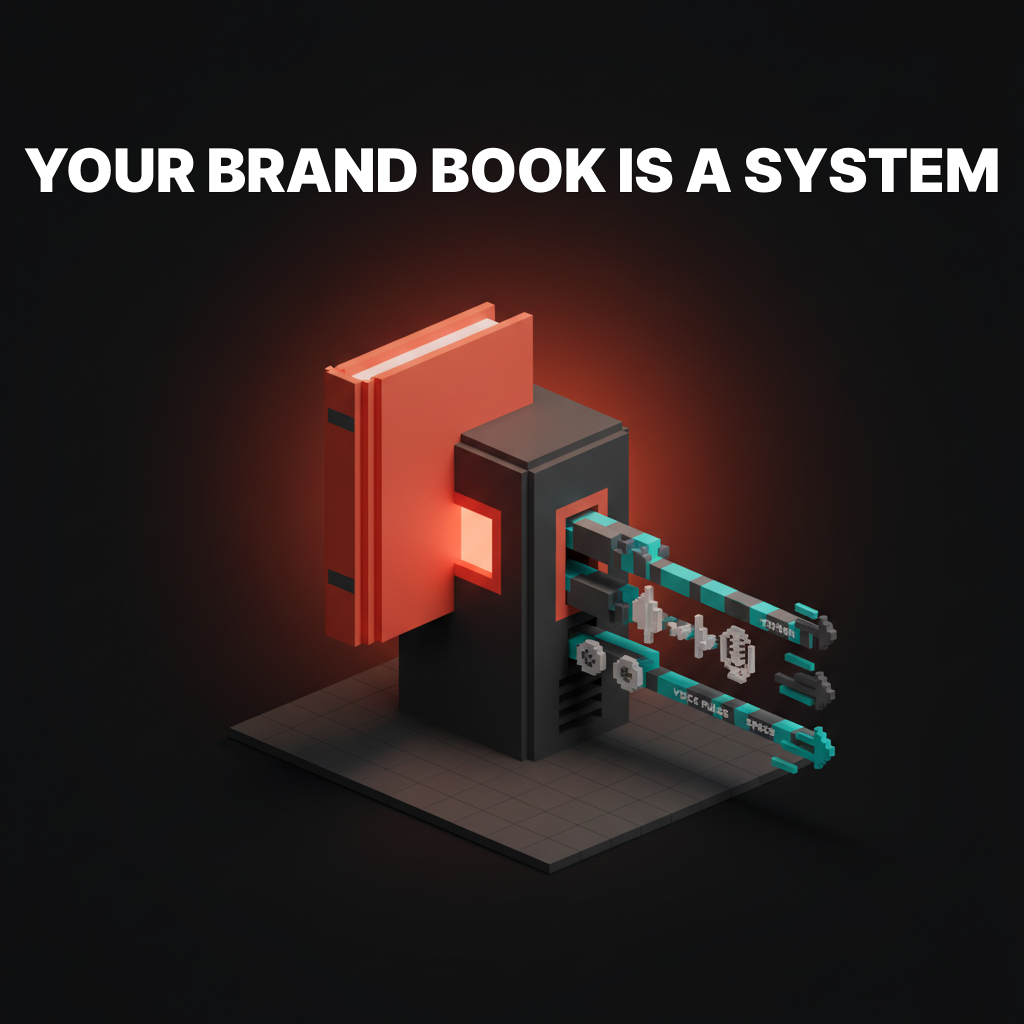
Your brand book is not a PDF. It is an API your team, your tools, and your AI all read from.
What a 2026 brand book actually does
A modern brand book has one job: make it impossible to produce off-brand work, no matter who or what is producing it.
That means the book has to be readable by three different audiences at the same time. The designer who needs to understand intent. The tool (Figma, After Effects, a CMS) that needs machine-readable rules. The LLM that needs voice guidance it can apply to a draft blog post at 2 a.m. without supervision.
Most agencies still deliver for only the first audience. The work looks great in the presentation and degrades the moment it leaves the room.
| What old brand books had | What 2026 brand books need |
|---|---|
| Hex color list | Layered design tokens (primitive, semantic, component) |
| "Friendly but professional" voice paragraph | Voice rules an LLM can follow, with examples |
| Static logo files | Logo as a component system with variants |
| One print-spec grid | Responsive rules and social-first aspect variants |
| "Use on-brand imagery" | AI image generation prompts and negative prompts |
| A PDF | A versioned, linkable, machine-readable system |
If your current brand book does not cover the right column, it is a relic. Rewrite it.
Design tokens replace hex value lists
The single biggest upgrade in the 2026 brand book is design tokens. A hex value sitting in a PDF is a suggestion. A design token is infrastructure.
Tokens work in three layers, and you need all three. Primitive tokens are the raw values: color.yellow.400 = #FFC44D. Semantic tokens name the intent: color.accent.primary = {color.yellow.400}. Component tokens name the usage: button.primary.background = {color.accent.primary}.
When you change one primitive, every downstream token updates. Rebrand becomes refactor. A junior dev can swap the accent without touching a single component.
Your brand book needs tokens for color, typography (sizes, weights, line heights), spacing, radius, shadow, and motion durations. Publish them as JSON or through a platform like Tokens Studio. Do not publish them as a printable swatch grid and call it a day.

Voice rules an LLM can actually follow
Here is where most brand books embarrass themselves. The voice section is two paragraphs of adjectives. "Confident, approachable, witty, warm." None of that is a rule. An LLM cannot follow an adjective.
A 2026 voice section needs concrete instructions. Sentence length limits. Specific words the brand uses and a specific list it never uses. Point-of-view rules (first person plural? second person?). Em dash policy. Emoji policy. How the brand opens an article versus how it closes one.
Then you need examples. For every voice rule, show an on-brand sentence and an off-brand sentence. "We help you scale" versus "Let's scale together." "Our platform enables" versus "You get." The LLM learns from the pairs, not from the adjectives.
This section doubles as the system prompt for any AI tool your team uses. If your voice rules cannot be pasted into a Claude or ChatGPT system prompt and produce on-brand output, they are too vague. See brand voice for the primitive version of this.
Motion principles belong in the book
Most brand books still treat motion like it is a specialty concern for the animation team. It is not. Every product UI, every scroll-triggered landing page, every social video expresses your brand through motion whether you wrote a rule for it or not.
Put motion in the book. You need three things: a curve library (the easing functions your brand uses, usually three to five), duration tokens (fast, base, slow, expressed in milliseconds), and a small set of signature motion patterns (how does a card enter, how does a modal open, how does a hero reveal).
Write them as tokens when you can: motion.duration.base = 240ms. Write them as principles when you cannot: "We ease in fast, ease out slow. No linear curves. No bounces." A motion spec the animation team and the Framer-using marketer both obey is non-negotiable.
Accessibility is a baseline, not a chapter
Old brand books put accessibility in a one-page appendix that said "meet WCAG AA where possible." Translation: nobody checked, nobody cared.
A 2026 brand book bakes accessibility into the tokens. Every color pair has a documented contrast ratio. Every font size has a minimum viable application. Every interactive component has a focus state defined. The book does not say "try to be accessible." It makes it structurally hard to be inaccessible.
Ship a baseline. WCAG AA minimum for all body text, AAA where the brand can afford it. Motion rules include a reduced-motion variant. Color rules include a documented color-blind-safe version of the palette. If a new designer can ship an inaccessible artifact without violating a specific rule in the book, the book is broken.
AI image generation needs its own rules
By 2026, half of the imagery your brand ships is being generated or edited by AI. If your brand book does not have rules for that, you have ceded your visual identity to whatever default aesthetic Midjourney, Gemini, or the next tool picks.
The AI image section needs four things. A style prompt your team can paste into any image model to get on-brand output. A negative prompt (things the brand never shows, usually a list of twenty cliches you are allergic to). A set of reference images representing the correct aesthetic. And rules about when AI images are appropriate and when they are not (editorial yes, portraits of real people no, product renders it depends).
This is the most underbuilt section of every brand book we audit. Fix it first if you are rewriting yours.
Social-first variants are not an afterthought
The old brand book treated social like a downstream artifact. Design the campaign for the hero landing page, then "adapt it" for social. That is how you get cropped heads and illegible text on every Instagram post.
Modern brand books design for social first, then scale up. You need aspect ratio variants baked into the book: 1:1, 4:5, 9:16, 16:9, and a couple of story-native formats. Each variant has its own typography minimums, safe zones, and logo placement rules.
Your hero imagery should be shot or composed with the 9:16 crop in mind, because that crop is where the majority of impressions live. If the brand book treats the desktop hero as the source of truth and everything else as a degraded copy, you are building backwards.
Show what NOT to do (the edge cases)
The section almost every brand book skips is the most useful one. Show what off-brand looks like.
For every major rule, include a "do not" panel with a real-looking example of the violation, annotated. Logo on a busy background. Headline with the wrong weight. AI-generated image in the brand's forbidden style. A subhead that breaks the voice rules. The sentence "Let's synergize our growth journey."
People learn from the edges. A rule stated abstractly gets ignored. A rule shown visually, next to a specific example of the wrong answer, gets internalized. Make the book critical, not just prescriptive.
For the underlying system this fits into, see how to create a brand identity and the brand identity examples worth studying we broke down separately.
The 2026 brand book table of contents
Use this as a baseline. Edit from here, do not build from scratch.
1. Foundation
- Mission, positioning, audience (one page each)
- Brand story in 150 words
- Personality attributes with negative space ("we are X, we are not Y")
2. Visual Identity
- Logo as a component system (primary, secondary, mark-only, wordmark-only, inverse, mono)
- Clear space rules with tokenized values
- Do-not panel with real examples of misuse
3. Design Tokens
- Color tokens (primitive, semantic, component)
- Typography tokens (family, size, weight, line height)
- Spacing, radius, shadow, elevation tokens
- Motion duration and easing tokens
- Published as JSON or via Tokens Studio
- Primary and secondary typefaces with usage rules
- Type scale and pairing examples
- Language support notes (which scripts the brand has commissioned)
5. Color System
- Palette with documented contrast ratios for every pair
- Color-blind-safe variants
- Usage ratios (60/30/10 or whatever the brand uses)
6. Imagery
- Photography direction with five to ten reference shots
- Illustration system with component examples
- AI image generation prompts (positive and negative)
- Video direction and b-roll guidelines
7. Motion
- Easing curve library
- Duration tokens
- Signature patterns (hero reveal, card hover, modal open, page transition)
- Reduced-motion variant
8. Voice and Language
- Voice rules with on-brand and off-brand sentence pairs
- Vocabulary list (words we use, words we never use)
- POV, tense, and grammar rules
- Em dash, emoji, and punctuation policies
- LLM-ready system prompt version
9. Accessibility
- WCAG baseline commitment
- Contrast, sizing, and focus-state rules
- Motion and color-blind considerations
10. Applications
- Social-first variants (1:1, 4:5, 9:16, 16:9)
- Web component examples
- Product UI component set
- Print and merchandise rules
- Partnership and co-branding rules
11. Governance
- Who owns the book
- How changes get proposed and approved
- Versioning (semantic versions, changelog)
- Where the canonical source lives (Figma, GitHub, Notion)
12. Examples
- Ten or more applied examples across every medium
- Annotated do and do-not pairs
- Links to live production work
Copy it. Edit it. Ship it.
FAQ
What is the difference between a brand book and a brand style guide?
In 2026, nothing. The terms have collapsed. Some agencies still use "brand book" for the strategic document (positioning, voice, values) and "style guide" for the tactical document (logo rules, colors, typography). Treat them as one living system. The split was never useful and a modern brand book covers both.
How long should brand guidelines be?
As long as your team and your tools need, and not a page longer. The old 80-page PDF was mostly filler. A modern brand book is shorter in prose and longer in structured assets. Ten tight pages of principles plus a full set of tokens, components, and examples beats a 100-page PDF every time.
Do small businesses need brand guidelines?
Yes, and they need them sooner than they think. The moment a second person starts producing content, you need rules. For small teams, the book can be a single Notion page with tokens, a voice section with five rules and ten example sentences, and a Figma file with the logo component. That is enough to stop brand drift.
How often should brand guidelines be updated?
Treat it like software. Minor versions when you add a new component or token (monthly is normal). Major versions when the system changes (every 18 to 36 months). If your brand book has not been touched in three years, it is already out of date.
Ship the book your team will actually use
The best brand book in 2026 is the one that gets opened. Not admired in a presentation. Not locked in a PDF. Opened, linked, copy-pasted, fed into a system prompt, referenced during a pitch, updated on a Tuesday morning.
Audit what you have right now. If your current book cannot produce on-brand social variants, feed tokens to Figma, guide an LLM, and show a new hire what NOT to do, it is not a brand book. It is a memento from an old meeting.
Rewrite it. Structure it. Version it. Then make it the first link in your onboarding doc, the system prompt in your content AI, and the source of truth every tool in your stack reads from. That is the book that protects your visual identity and your brand system at the same time.
Need brand guidelines that your team will actually use? Brainy builds brand systems that ship.
Need brand guidelines that your team will actually use? Brainy builds brand systems that ship.
Get StartedGet new papers by email
New Brainy papers in your inbox. Confirm once, unsubscribe anytime.