
Productized Design Services: A Solo Designer's 2026 Playbook
What productized design services are, the real businesses proving the model (Designjoy, Design Pickle, Superside), how to scope and price a design subscription, and when not to.
Productized Design Services: A Solo Designer's 2026 Playbook
Hourly billing caps your income at the number of hours you can stay awake. A product does not.
That is the entire case for productized design services in one sentence. Everything below is the mechanics of actually building one.
What a productized design service actually is
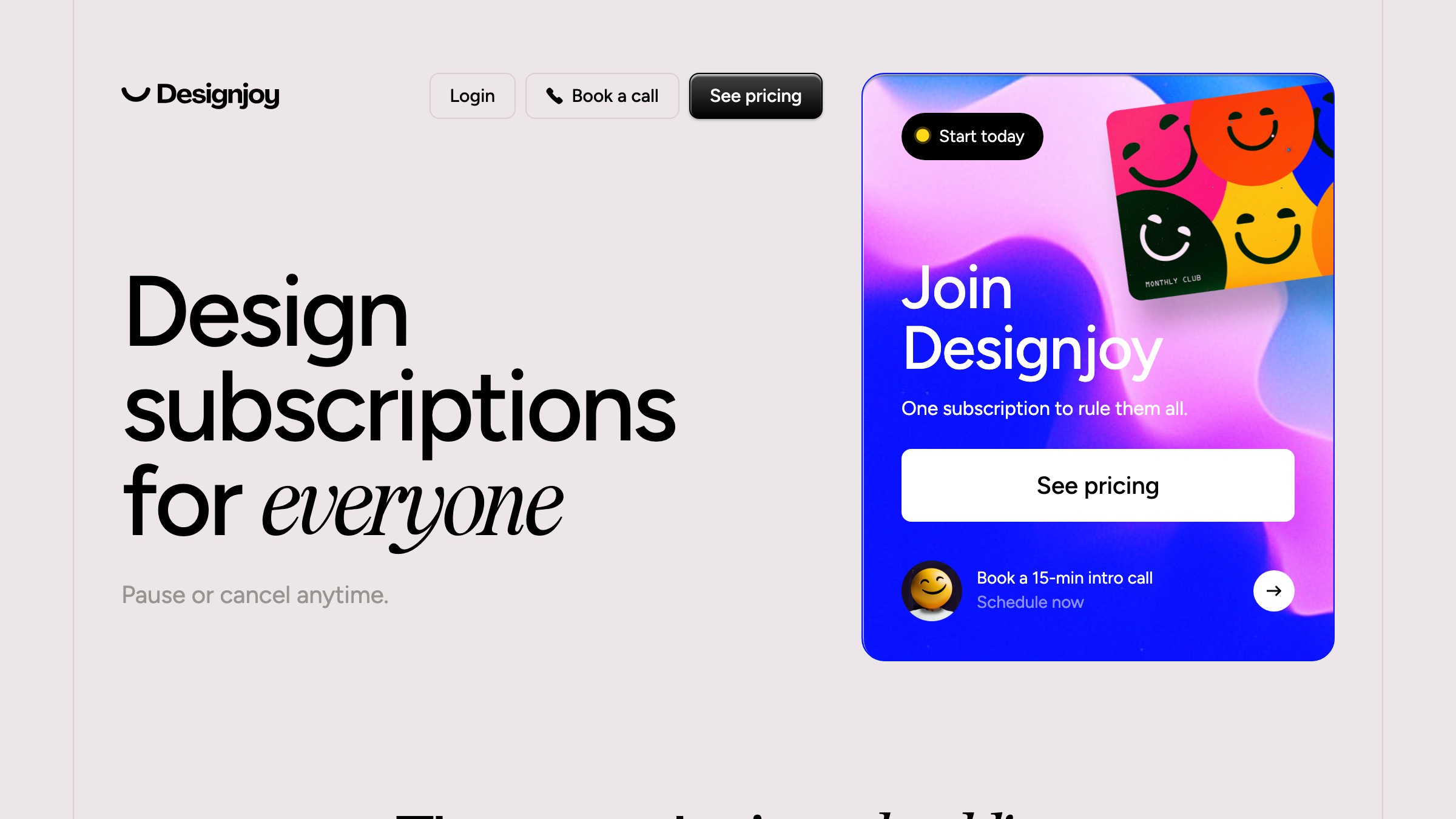
A productized design service is a subscription where the client pays a fixed monthly fee and the designer delivers a defined scope of work on a defined turnaround. The scope is fixed, the price is fixed, and the client submits requests the designer works through in a queue. No custom proposals, no scope negotiations, no "just a quick change" billing debates. Designjoy, the best-known example, runs this exact shape at $4,995 a month with one active request at a time.
This is fundamentally different from a retainer. A retainer sells hours. A productized service sells output. That sounds semantic until you price it, because a retainer's ceiling is your hourly rate times the hours you sold, while a subscription product's ceiling is how many clients you can serve before the queue breaks.
Why the model took over
The shift started around 2020 and accelerated sharply through 2022 to 2024 for three reasons:
- Async tools matured, so clients stopped caring whether their designer was free on a Tuesday afternoon.
- AI cut the time per task on repeatable work, letting one person handle volume that used to need a small team.
- Subscription psychology took hold, where clients who flinch at a $5,000 project invoice will sign a $3,000 a month plan without blinking.
The third reason is the most underappreciated. Subscriptions feel like software spending, not service spending. Finance departments have a budget line for it. Project budgets do not.
Three real businesses worth studying
These three are not the same business at different sizes. They made different bets.
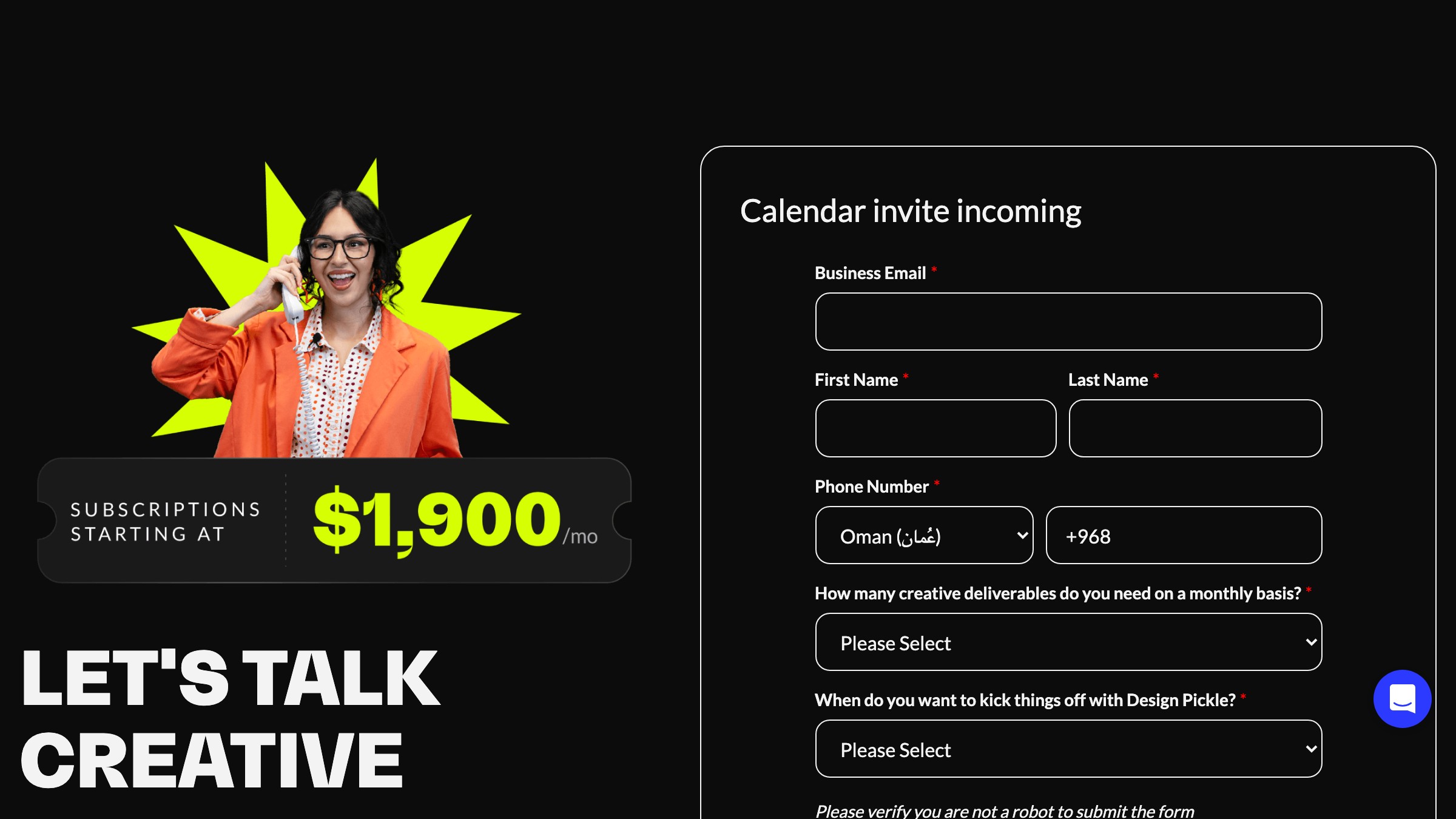
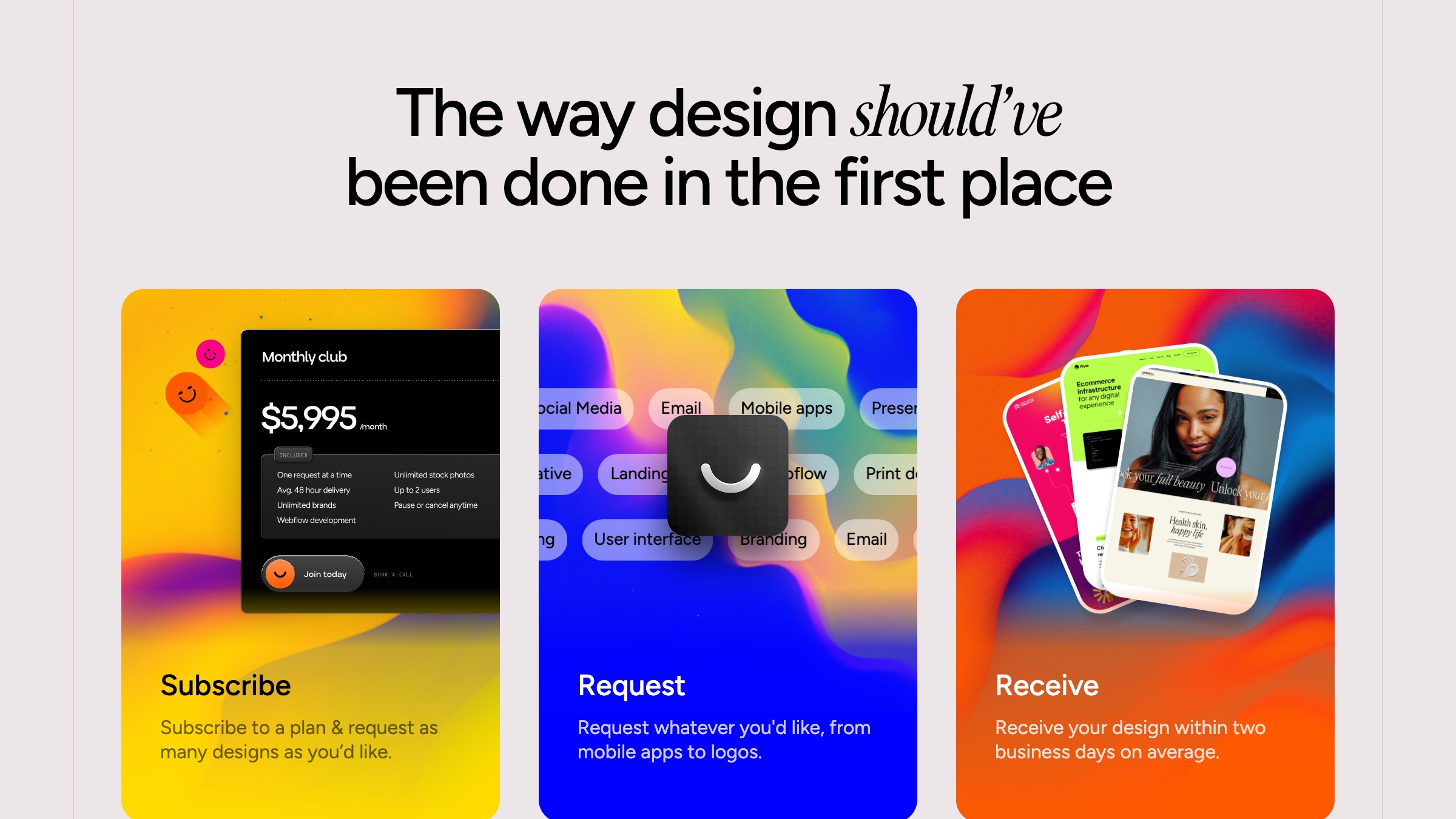
See it live on designpickle.com
| Business | Scale | Model detail | What it proves |
|---|---|---|---|
| Designjoy (Brett Williams) | Solo | One person, $4,995-$7,995/month, one active request at a time per client, 1-2 day turnaround, pause or cancel anytime | A single designer can generate $1M+ ARR with zero employees using this model |
| Design Pickle | Agency (100+ team) | Tiered subscriptions from ~$499-$1,695/month, dedicated designers per client, graphics to video motion | The model scales with headcount; each tier is essentially a seat with defined output |
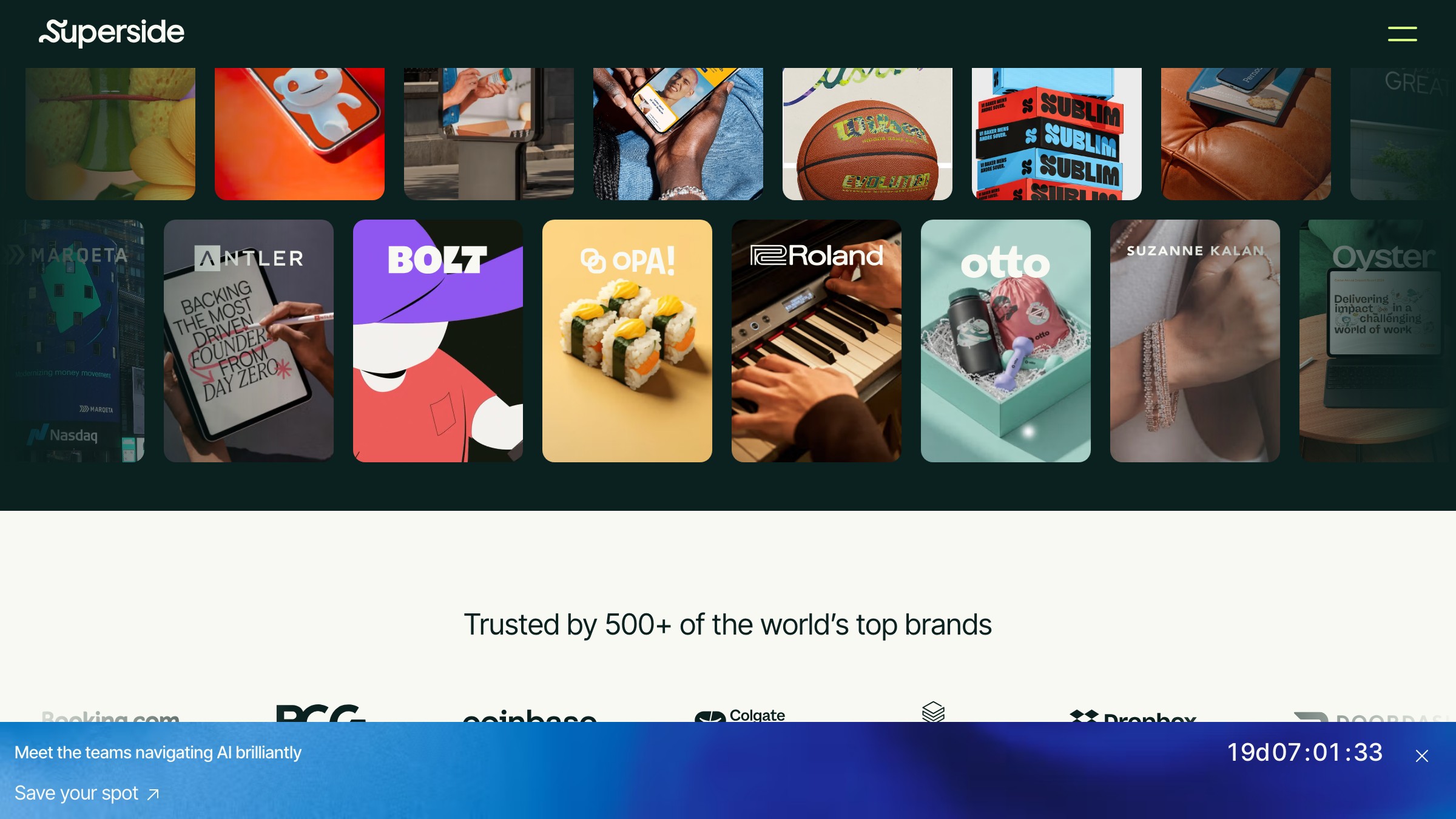
| Superside | Enterprise | Custom pricing, always-on creative teams embedded into client orgs, targeting Series B+ companies | The same subscription logic works at the enterprise end when scope, team size, and SLA are the product |
Designjoy is the one to study hardest if you are a solo designer. Brett Williams built it to a reported $1M+ ARR as a one-person operation, with no employees. The product is not unlimited design, a term that creates scope chaos. It is one request at a time, delivered fast, with a clear queue, and that constraint is the product.
Design Pickle named the category, one of the first to sell "unlimited design" at a flat rate. Their current tiers define scope far better than that early unlimited framing, a lesson learned the hard way.
Superside shows the logic travels up-market. At the enterprise end, the subscription is a pod of creatives with project management and brand governance baked in. Same model, bigger scope.
For more on the business of design, see the Brainy Papers library.
How to scope an offer that does not eat you alive
Most designers who productize fail not because they price wrong but because they scope wrong. "Unlimited design" is not a scope. It is a commitment to work until you break.
A workable scope has three components: what request types are included, how many active requests the client holds at once, and what the turnaround is. Everything outside those three parameters is a change order or an upsell, not a scope problem.
Use this worksheet to define yours before you set a price:
| Component | Your answer | Example (solo) |
|---|---|---|
| Request types included | List specifically | Social graphics, deck slides, brand collateral, landing page sections |
| Request types excluded | List specifically | Logo design, full brand identity, video, illustration |
| Active requests per client | One number | 1 at a time |
| Turnaround per request | One number | 1-2 business days |
| Revision rounds included | One number | Until you're happy (on same brief) |
| What "done" means | Define completion | Delivered as specified in the brief |
| What triggers an upsell | Be specific | Requests requiring more than 4 hours, new brand identities, print production |
The revision policy is where most solos bleed. "Until you're happy" only works when the brief is tight. Add a brief template to your onboarding and the revision loops shrink to almost nothing.
The subscription pricing math
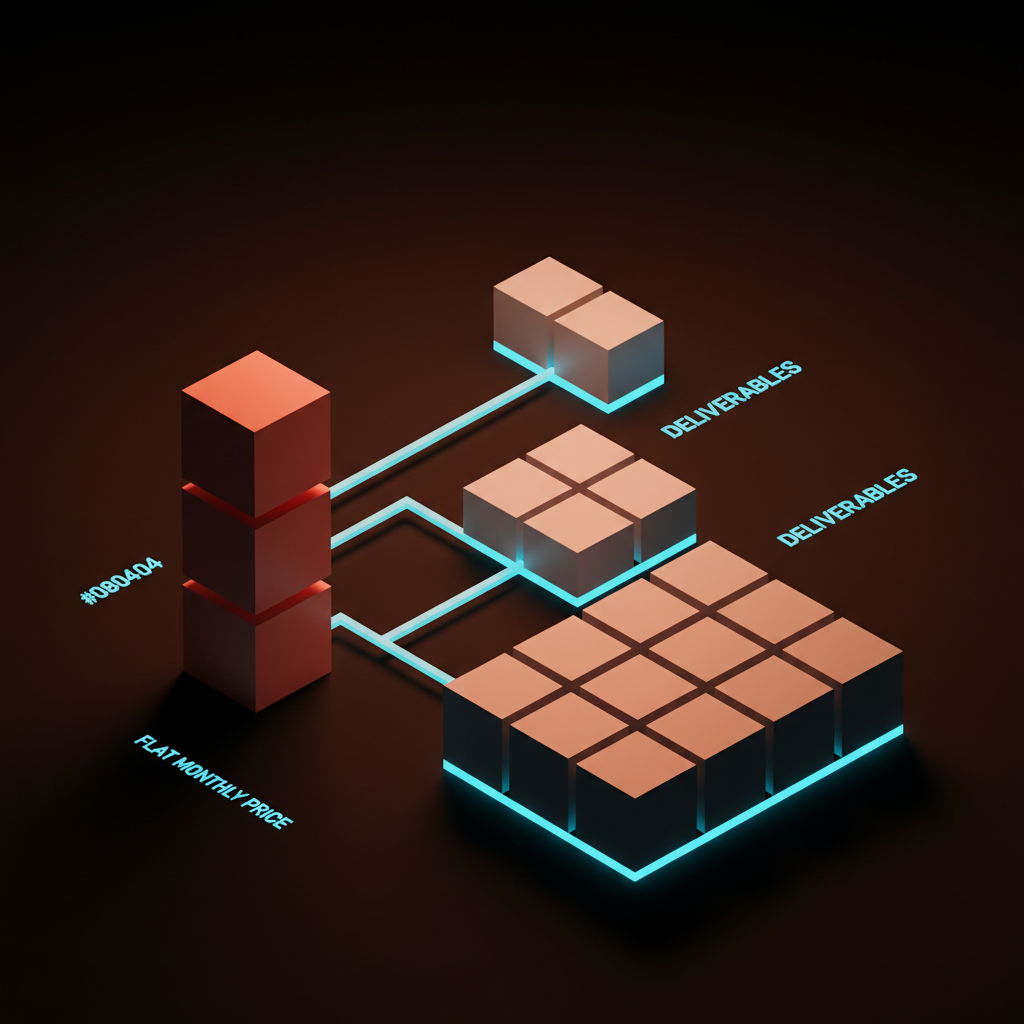
Price to your capacity, not to the market rate. The calculation is simple:
- Decide how many clients you can serve without missing turnarounds
- Divide your target monthly revenue across them
- The result is your floor per client
Say you want $15,000 a month and can serve 5 clients without burning out. That puts your floor at $3,000 per client per month. The market ceiling for a solo design subscription runs roughly $7,500 to $10,000 a month, with Designjoy sitting near the top at $7,995. Your price lives somewhere between your floor and that ceiling based on your positioning.
Where most solos go wrong: they price at the market rate first and then count clients, which locks them into needing 8-10 active clients to hit revenue goals. Eight active clients means eight queues to manage. That is an agency you did not realize you were building.
Two tiers is usually better than three for a solo operation. One tier at full engagement, one tier for clients who need lighter volume. More than two tiers creates a sales conversation you do not want to have.

The systems that make it run in 2026
A productized service without systems is just a chaotic retainer with a flat fee. The systems are what make the product run when you are not thinking about it. Superside runs this same operating model at the enterprise end, just with a larger team standing behind the queue.
The minimal stack that actually works:
| System | Tool (2026 options) | What it does |
|---|---|---|
| Request intake | Notion form, Linear, or a simple Typeform | Forces clients to brief properly before a request enters the queue |
| Queue management | Trello, Linear, or Notion board | One-look visibility into every active request |
| File delivery | Shared Figma workspace or Google Drive | Client always knows where to find their work |
| Billing | Stripe or Paddle with monthly recurring | Automated, no invoice chasing |
| Communication | Loom for async review | Cuts back-and-forth by half; clients watch a 2-minute video instead of writing five emails |
The 2026 unlock is AI on the repeatable work. Resizing deliverables across formats, drafting copy for social cards, spinning up mockup variations, and prepping export-ready assets used to eat 30 to 40 percent of a designer's execution time. With current tools like Figma AI and Adobe Firefly workflows, that overhead is closer to 10 to 15 percent. One person can now run a subscription that would have needed two junior designers in 2021.
This is not hype. It is the arithmetic reason the solo model works at price points that were unsustainable three years ago.
If you want a deeper look at the AI side of this, running a one-person studio with AI covers the toolkit in detail.
When productizing is the wrong call
The model has real failure modes. Knowing them in advance is cheaper than discovering them after you have signed four clients.
It kills creative range. A design subscription self-selects for repeatable work. If you produce social graphics month after month, you get very fast at social graphics and you stop doing anything else. Designers who need variety to stay sharp will find the model suffocating inside six months.
The queue can drown you. High-volume clients who submit requests every day will fill your queue faster than you can clear it. Without a strict one-active-request limit and a real turnaround commitment, you end up with a backlog and a client relations problem.
Not every discipline productizes cleanly. Brand strategy, UX research, custom illustration, and complex motion work are difficult to scope at a fixed monthly price without either under-delivering or working at a loss. The model works cleanest for execution-heavy, repeatable creative: social content, marketing collateral, web design components, presentation design.
Cheap tiers attract the wrong clients. Sub-$1,000/month subscriptions tend to attract clients who treat the service as a personal art department with unlimited requests. The friction of the price point weeds out this behavior at the $3,000+ tier.
Use this table before committing to the model:
| Question | If yes | If no |
|---|---|---|
| Is most of your work repeatable execution? | Productize | Bill by the hour or project |
| Can you define your scope in writing without hedging? | Productize | Do not productize yet |
| Do you want predictable monthly revenue more than creative variety? | Productize | Stay on project-based work |
| Can you handle pause/cancel churn without cash flow panic? | Productize | Build a cash buffer first |
| Are you willing to say no to requests outside the scope? | Productize | Hourly is more honest |
For more on how to price your design work across models, see how to price brand work.
FAQ
How is a productized design service different from a retainer?
A retainer sells time, a productized service sells output. On a retainer, the client buys hours and decides how to spend them. On a subscription, the client buys a defined scope, and the designer controls how the hours are spent to deliver it. The difference is who owns the workload definition.
Can one person actually run a design subscription solo?
Yes, and Designjoy is the clearest proof. The constraint is client count, not ambition. Most solo operators run 4 to 8 clients depending on scope, and AI tooling has pushed that ceiling up since 2022.
What design work productizes badly?
Brand strategy, primary research, complex motion, custom illustration, and anything that cannot be defined in a brief before work starts. These need dialogue and iteration that does not fit a queue model.
What should I charge?
Price to your capacity first (see the math section above). For a solo designer in 2026, the functional range for a credible subscription is $2,500-$7,500/month depending on scope, turnaround, and your positioning. Under $2,500 and the economics rarely work. Over $7,500 solo and you are competing with small agencies.
Do I need a contract?
Yes. The subscription agreement should define scope, turnaround, revision policy, what triggers an out-of-scope charge, pause terms, and cancellation notice period. Without this, every edge case becomes a negotiation.
Stop selling hours
The productized model is not a shortcut. It is a different business than freelancing, with a higher ceiling that only opens up with real scope discipline and systems that hold at capacity.
The designers who pull it off are not the ones with the best portfolio. They are the ones who treated their work like a product, defined what it does, priced it to what it costs to deliver, and said no to everything outside the scope.
That is the entire playbook.
Brainy helps designers turn craft into a business that ships. See what we are building for creators.
Brainy helps designers turn craft into a business that ships. See what we are building for creators.
Get StartedGet new papers by email
New Brainy papers in your inbox. Confirm once, unsubscribe anytime.