
How to Price AI-Augmented Design Work in 2026: Rates, Packaging, and What Clients Actually Pay
A working pricing playbook for designers shipping AI-augmented work in 2026. Real 2026 rate bands by region, the four pricing models reframed for AI, packaging examples clients can buy, and the honest discount math on when AI lets you charge more vs less.
AI did not kill design pricing in 2026. It split the market. Studios that price AI-augmented systems are charging more than they did in 2024. Freelancers selling speed are racing to the bottom. The right move is to price the outcome, not the hours saved, and to package the AI in a way clients can actually buy.
This is a working playbook. Four pricing models reframed for AI-augmented work, real 2026 rate bands by region, four packages that close deals, the honest discount math, and the four anti-patterns that turn AI into a discount coupon for your clients.
AI did not kill design pricing, it split the market
Freelancers tell themselves clients now expect AI-priced work. Studios are quietly living the opposite. Clients buying brand systems, design tokens, and AI integrations are paying more in 2026 than they paid in 2024 for plain design.
What changed is the deliverable. A logo with usage guidelines used to be the ceiling. A brand system with a matching prompt pack, a Figma MCP integration, and a token library that ships as code is the new ceiling. The price moved with it.
The studios that lost ground kept selling the old deliverable and quietly used AI to make it. They got the speed gain, handed it to the client, and watched the margin disappear.
The four pricing models, reframed for AI
Hourly, project, retainer, and value-based are still the four pricing models. AI breaks each one differently. Knowing which one to use is the first move.
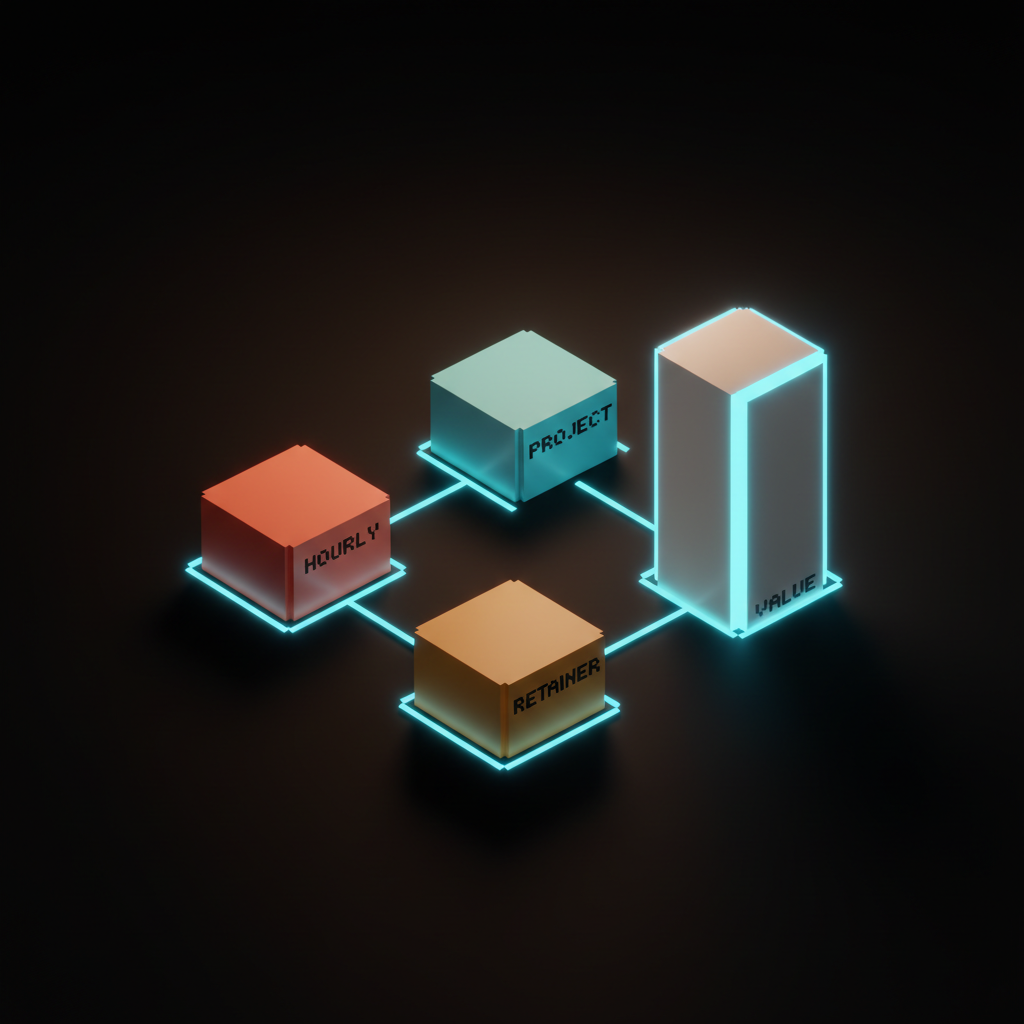
Hourly is the trap. Project is the default. Retainer is the scaling lane. Value is the ceiling. Most AI-augmented designers should run on a mix of project and retainer, with value-based pricing reserved for engagements with measurable revenue or risk reduction.
Hourly is the trap, not the model
Hourly is how AI-augmented designers leave the most money on the table. AI compresses the hours. It does not compress the value. If your work used to take forty hours and now takes eight, charging the same rate just cut your fee by eighty percent for the same deliverable.
The honest path is to move off hourly, or raise the rate by the speed multiplier. Senior freelancers who stayed on hourly through 2025 quietly raised rates from a 2024 band of $90-$150 to a 2026 band of $150-$250 per hour. That is the multiplier in the rate, not in the bill.
Hourly still makes sense for one thing. Discovery and strategy where the deliverable is the conversation itself. Outside that, hourly is a tax you pay for not productizing your work.
Project pricing is where most studios should land
Project pricing is the default for AI-augmented work in 2026. It prices the outcome, the scope is fixed, and AI just makes the margin better. The client buys a brand system, a website, a product UI, an identity refresh. The studio prices the deliverable. The AI in the workflow is the studio's tooling, not the client's discount.
For brand identity pricing specifically, 2026 project bands sit at $8K-$25K for logo-only, $25K-$60K for a full identity, $50K-$150K for a brand system, and $150K-$400K for a brand system with prompt pack and token library. The AI-augmented top tier carries a thirty to fifty percent premium over the 2024 equivalent because the deliverable is bigger.
Project pricing only works when the scope is real. Vague scope plus AI tooling is how studios eat scope creep at zero margin. Lock the scope in writing, list every deliverable, price every revision round.
Retainers are how AI-augmented studios scale
Retainers are the cleanest fit for AI-augmented work. The systems compound. The prompt library gets sharper every month. The Figma library, the token system, and the Skill pack the studio built for the client in month one keep paying off in month six.
A 2026 AI-augmented retainer for a seed-to-Series-A startup runs $8K-$20K per month for a fractional design partner with prompt and Skill maintenance. A growth-stage retainer with multiple workstreams runs $20K-$50K per month. The studio invests once in the AI infrastructure and bills the maintenance as recurring revenue.
The retainer trap is treating it like an unlimited request queue. It is a scoped monthly commitment with a defined surface area, response window, and deliverable rhythm. Without those three guardrails, studios burn out and lose the margin AI was supposed to give them.
Value-based pricing is the ceiling, not the floor
Value-based pricing is where AI-augmented designers earn the highest rates. It only works when the deliverable ships measurable revenue or risk reduction. A landing page that lifts conversion two points on a SaaS doing ten million in ARR is worth six figures. A brand system that lets a Series B raise a Series C is worth multiples of a project price.
The catch is most engagements do not qualify. Value-based pricing requires a measurable lift, a baseline you can defend, and a client sophisticated enough to attribute it to the design work. Miss one and you are doing project pricing with a fancier name.
When it does qualify, value-based fees on AI-augmented work in 2026 routinely clear $250K to $1M for a single engagement. That is the ceiling, reserved for studios with a track record clients can underwrite.

Real 2026 rate bands by region
Rates have stratified by region in 2026, and the US senior freelance band is now decoupled from EU, LATAM, and SEA bands by a wide margin. Senior freelance in the US runs $120-$250 per hour. Senior freelance in the EU runs $80-$160 per hour. Senior freelance in LATAM runs $40-$90 per hour. Senior freelance in SEA runs $30-$75 per hour.
Project bands follow the same shape. A full identity from a US studio sits at $25K-$80K. EU $18K-$55K. LATAM $9K-$30K. SEA $7K-$22K.
The split is not closing. Clients pay more for proximity, time zone overlap, and the tax surface their finance team understands. AI-augmented studios in lower-cost regions compete on price and quality, but the top of the band still concentrates in the US and EU.
The other split nobody publishes. Studios with a productized AI offering charge twenty to forty percent more than studios shipping the same deliverable without one. The premium shows up because the deliverable is bigger and the client can see it.
Four AI-augmented packages clients actually buy
Clients do not buy "AI-augmented design." They buy specific deliverables. These four packages are what closes deals in 2026.
Brand systems with prompt packs
A brand system shipped with a matching prompt pack is the highest-margin package on the menu in 2026. The system is the usual: marks, type, color, motif, voice, guidelines. The prompt pack is the thing the client keeps. A library of prompts the marketing team can run inside ChatGPT, Claude, or Midjourney to produce on-brand assets without going back to the studio for every social post. Price band: $80K-$250K depending on system depth.
Figma MCP integrations
Figma MCP integrations are the package that wins designer-to-developer engagements. A Model Context Protocol server that exposes the design system, the component library, and the token set to AI code editors like Cursor, Windsurf, or Claude Code, so developers ship pixel-perfect components without the back-and-forth. Price band: $25K-$80K for the integration plus a maintenance retainer.
Claude Skills bundles
Claude Skills bundles are the productized retainer of 2026. A pack of Claude Skills the client's team uses to run brand reviews, content audits, asset generation, and design QA. The bundle ships with documentation, example prompts, and a quarterly tune-up. Price band: $15K-$45K for the build, $3K-$8K per month for maintenance.
Design tokens that ship as code
Design tokens that ship as production-ready code are the package that justifies a senior rate. The deliverable is engineering output. Tokens for color, type, spacing, motion, elevation, and component primitives, exported as TypeScript, CSS variables, Tailwind config, and platform-native iOS and Android files. Price band: $35K-$120K depending on platform count.

Building an AI-augmented design practice and need a studio that prices it without hiding behind "it depends"? Hire Brainy. BrandBrainy ships brand systems with prompt packs at fixed scoped rates, and ClaudeBrainy ships Skill bundles and Figma MCP integrations as productized retainers.
The honest discount math
The hardest question in AI-augmented pricing is when to discount for speed and when to charge more. One rule. If AI compressed the hours but the deliverable is the same, do not discount. If AI expanded the deliverable, charge more. If AI reduced the deliverable below what the client needs, do not take the engagement.
Most studios get this wrong by reflex. They feel guilty about the speed gain, drop the price, and train their market to expect cheaper work forever. The client does not feel like they got a deal. They recalibrate their budget, and the studio's ceiling drops permanently.
When AI lets you charge more
Three conditions trigger a premium. The deliverable expands beyond the pre-AI workflow, like a brand system with a prompt pack and a Skill bundle. The turnaround is materially faster and the speed has value, like a launch deadline impossible at the old pace. The output quality is higher because AI handled the work that used to absorb senior time, freeing that time for the strategy the client is actually paying for.
Most studios miss at least one. Spell them out in the proposal. Show the client what the deliverable used to be, what it is now, and which trigger applies. Pricing rises with the deliverable.
When a discount is actually fair
Discounts make sense in exactly two scenarios. First, repeat engagements where the studio is reusing prompts, Skills, and tokens built for a previous client and the new client benefits from the head start. A ten to fifteen percent discount on the second project in a series is honest, because the studio is genuinely faster on round two without losing margin. Second, long-term retainers where the prompt library and Skill pack mature over time and the studio passes some of the compounding gain back to the client.
Outside those two scenarios, discounting AI speed gains is how studios train their market to expect cheaper work forever. The race to the bottom starts with one apologetic discount.
Four anti-patterns that race studios to the bottom
First. The AI-as-discount pitch. The studio leads with "we use AI so we are cheaper," then watches the client benchmark the price against an offshore freelancer doing the same pitch. Fix: lead with the expanded deliverable, not the cost reduction.
Second. Hourly billing after a five-x speed gain. The studio kept the rate the same, the hours dropped by eighty percent, and the fee dropped with them. Fix: move to project pricing or raise the hourly rate to absorb the speed multiplier.
Third. The no-prompt-pack handoff. The studio uses AI internally, ships the deliverable, and keeps the prompt library private. The client gets the output but no leverage, and the studio leaves the highest-margin part of the package on the table. Fix: ship the prompt pack as part of the deliverable and price it accordingly.
Fourth. The undifferentiated AI design pitch. The studio's entire pitch is "we use AI." Every other studio's pitch is also "we use AI." Fix: pitch the specific package, the specific outcome, and the specific tooling. AI is the tooling, not the offer.
FAQ
How much should I charge for AI-augmented design work in 2026?
Project pricing for an AI-augmented full identity sits at $25K-$80K in the US, scaling to $250K-plus for full brand systems with prompt packs and token libraries. Senior freelance hourly bands are $120-$250 in the US. The right rate matches your region, your package, and the deliverable, not the AI tooling.
Should I discount my rate because I use AI?
No, unless you are reusing prompts and Skills from a previous engagement, or passing compounding retainer gains back to the client. Discounting AI speed gains by reflex is how studios train their market to expect cheaper work forever.
What pricing model is best for AI-augmented design?
Project pricing is the default. Retainers scale. Value-based is the ceiling. Hourly is the trap. Most studios should run project plus retainer, with value-based reserved for engagements with measurable revenue lift.
How do I package AI-augmented design services?
The four packages that close deals in 2026 are brand systems with prompt packs, Figma MCP integrations, Claude Skills bundles, and design tokens that ship as code. Pitch a specific package, not "AI design."
How do I avoid the race to the bottom?
Lead with the expanded deliverable, not the cost reduction. Move off hourly. Ship the prompt library as part of the package, not as a private internal tool. Differentiate on the specific outcome, not on the fact that you use AI.
The pricing shift AI-augmented design actually unlocks
AI did not commoditize design. It commoditized the parts of design that should have been commodities five years ago, and it left the strategic, system-level work standing alone with a higher floor. The studios pulling ahead in 2026 are the ones that priced for the new floor, not the old one.
The shift is the same one the AI code editors story keeps teaching. The teams treating AI as a discount on existing work are losing margin. The teams treating AI as a way to ship deliverables that did not exist before are charging more and closing more. Same lesson, different field. The same logic applies to vibe coding engagements where designers ship working product code as part of the deliverable.
If your AI-augmented practice is stuck in a pricing conversation about hours saved, the conversation is the problem. Price the outcome, package the AI in a way the client can buy, and let the deliverable carry the fee.
If you want help building an AI-augmented design practice that prices for the new floor, hire Brainy. BrandBrainy ships brand systems with prompt packs at fixed scoped rates, and ClaudeBrainy ships Skill bundles and Figma MCP integrations as productized retainers.
Building an AI-augmented design practice and need a studio that prices it without hiding behind "it depends"? Brainy ships brand systems with prompt packs at fixed scoped rates, and ClaudeBrainy ships Skill bundles and Figma MCP integrations as productized retainers.
Get StartedGet new papers by email
New Brainy papers in your inbox. Confirm once, unsubscribe anytime.