
UI vs UX: The Real Difference (and Why Most Explanations Are Wrong)
UI is not the wrapping paper. UX is not the gift. The real difference between UI and UX, what each role actually does, and who to hire for what.
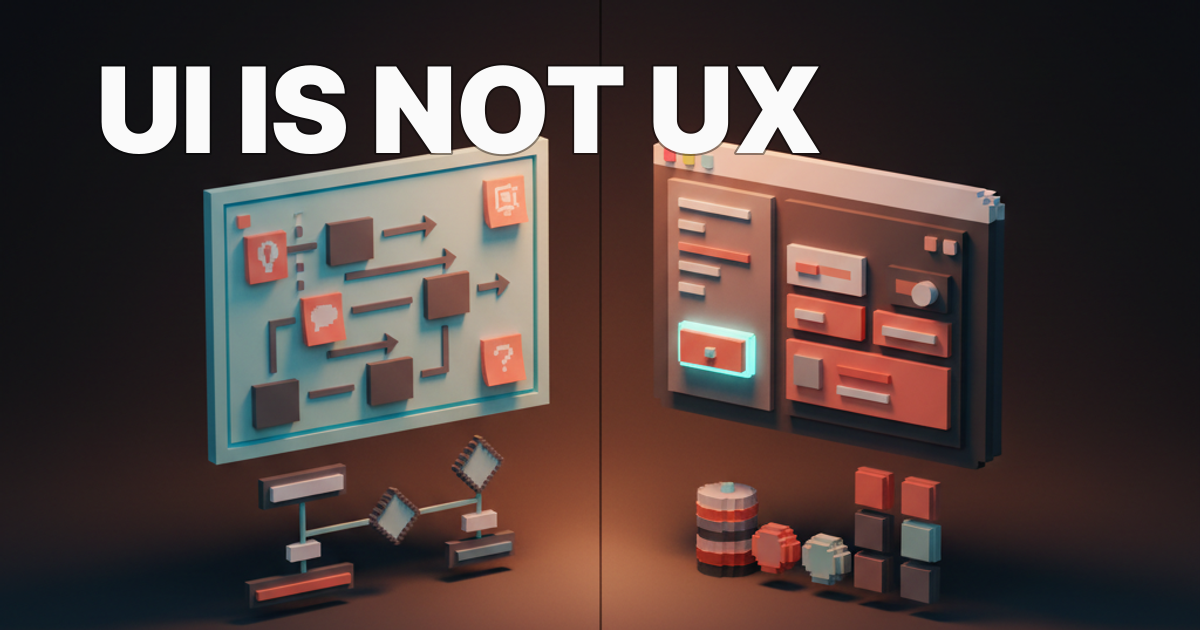
UI is not the wrapping paper. UX is not the gift. Also, UI is not the ketchup bottle, and UX is not pouring the ketchup.
Every "UI vs UX" explainer on the internet hides behind an analogy because the writer never actually did either job. The ketchup bottle analogy has taught a generation of designers absolutely nothing. A ketchup bottle has no hierarchy of tasks, no user research, no failure modes, no success metrics, no edge cases at 390px. You are not shipping a condiment. You are shipping software.
This paper kills the analogies, defines each discipline in one sentence, maps what each role actually ships day-to-day, and gives you a hiring framework you can use tomorrow.
The analogies are the problem
The dominant explanations treat UI and UX as physical metaphors because metaphors are easier to write than definitions. The cost is that every junior designer arrives at their first job believing UI is "colors and fonts" and UX is "the vibe." Both are wrong.
"UI is the car, UX is the drive" tells you nothing about information architecture. "UI is the house, UX is living in it" tells you nothing about journey mapping. "UI is visual, UX is interaction" is the most common version and also the most wrong. UI designers spend a huge part of their week on interaction states. UX designers spend a huge part of their week on visual decisions like information density and layout hierarchy. The line is not drawn where the analogies say it is.
Scrap all of it. Start from what each discipline actually decides.
The real definition, one sentence each
UX is the decision architecture. UI is the expression of those decisions on screen. That's it.
UX asks what should exist and when. What screens does this product need. What order does the user move through them. What information appears at each step. What happens when the user is confused, wrong, or in a hurry. What does success look like, and how do we know.
UI asks how those decisions look, feel, and move once they are on screen. What the hierarchy is, what the typography says, how a button behaves when pressed, how a modal enters, what a disabled state communicates, how the whole thing stays coherent across fifty screens and three devices.
Same product. Two different decision layers. One cannot ship without the other.
What a UX designer actually does
A UX designer's week is mostly research and structure, not screens.
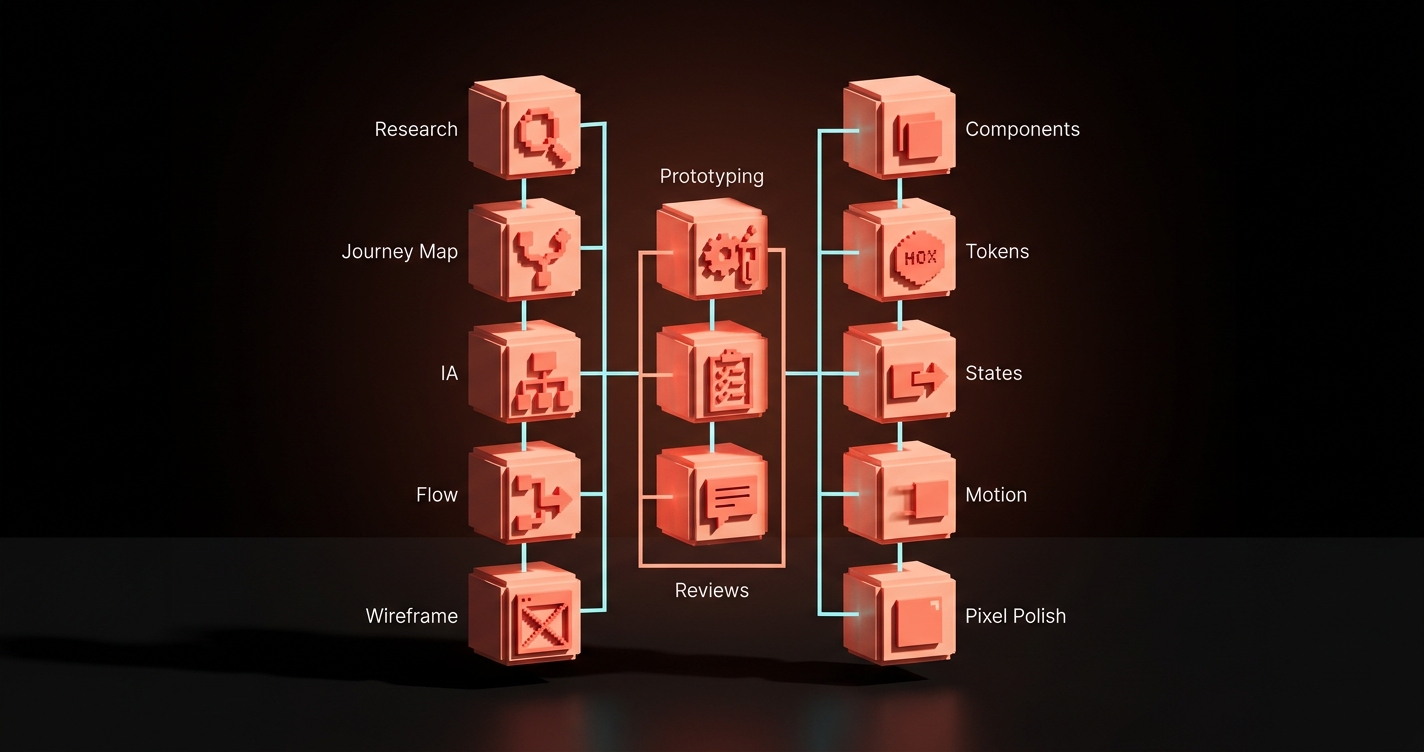
They run user interviews, review session recordings, and build journey maps. They draw information architecture, decide taxonomy, and argue with product managers about what a feature even is. They sketch flows. They build wireframes that nobody wants to look at because they are deliberately ugly. They validate assumptions by testing prototypes with real users, and they kill features that tested badly.
Typical UX deliverables:
- User research synthesis and personas
- Journey maps and flow diagrams
- Information architecture and content models
- Low-fidelity wireframes
- Usability test plans and reports
- Success metrics and instrumentation specs
The UX designer is the person who asks "should this screen exist at all" before anyone asks "what color is the button."
What a UI designer actually does
A UI designer's week is the opposite. They decide how the thing looks and behaves once UX has decided what it is.
They build visual systems. They set type scale, color tokens, spacing rhythm, and component specs. They design every interaction state (default, hover, active, focus, disabled, loading, empty, error). They define motion rules. They sweat pixel hierarchy across breakpoints and make sure the product feels like one product across every screen. They ship the component library and the design tokens that engineering actually consumes.
Typical UI deliverables:
- Visual design system (type, color, spacing, grid)
- Component library with all interaction states
- Design tokens exported to code
- Motion and transition specs
- High-fidelity screens and hi-res mockups
- Hand-off documentation for engineering
The UI designer is the person responsible for the product feeling coherent and alive, not just functional.
Where the overlap lives
The middle is where good products get made.
Prototyping is shared. Both roles build prototypes, UX to validate flows, UI to validate motion and polish. User testing is shared. UX designs the test, UI watches to see if their visual choices help or hurt comprehension. Design reviews are shared by definition, and they only work when both perspectives are in the room.
Here is the uncomfortable truth: a UI designer who doesn't understand UX ships pretty dead ends. A UX designer who can't execute visually ships strategy decks nobody implements. The good ones develop enough range on the other side to ship work that survives first contact with users. The best ones become product designers, which we'll get to.
The product designer question
"Product designer" is the title that ate the middle ground, and in 2026 it means one person who does both UI and UX to a credible bar.
At a startup, a product designer is often the only designer in the company. They own research, flows, wireframes, visual system, components, and motion. They are a one-person design team, and they work because a startup can only afford one person and needs both halves of the discipline.
At a larger company, a product designer usually owns a product area end-to-end and collaborates with specialist UX researchers, design system teams, and sometimes a motion designer. They are the generalist operator, not a junior hybrid.
The mistake most founders make is hiring a "product designer" when they actually need a senior UX researcher, or a "UI designer" when they actually need a product designer. Title inflation hides the real question, which is: what is the actual problem, and what skill mix solves it.
Tools, processes, outputs
A quick side-by-side. This is the compressed version, not a full spec.
| Dimension | UX Designer | UI Designer | Product Designer |
|---|---|---|---|
| Primary question | What should exist, and when | How should it look, feel, move | Both, end to end |
| Main tools | Figma, Miro, Dovetail, Maze | Figma, Framer, Principle | Figma, Framer, light code |
| Key deliverables | Research, flows, IA, wireframes | Visual system, components, states | All of the above, for one product area |
| Ships | Validated plans | Pixel-perfect screens + components | Validated, shipped features |
| Success metric | Task success rate, time on task | Visual consistency, usability scores | Product metrics (activation, retention) |
| Works closest with | PMs, researchers, analysts | Brand, design systems, frontend | PMs, engineers, everyone |
UI designers lean into visual hierarchy, token systems, and layout patterns like bento grids to make screens readable at a glance. UX designers lean into research loops, flow testing, and accessibility audits to make sure the product works for everyone it needs to work for. Product designers live in both rooms and usually end up owning landing page structure too, because conversion work does not sit cleanly inside either specialist role.
Tool-wise, everyone uses Figma. Arguing about tools is how designers avoid arguing about the actual work. If you want the short list of what's worth installing, the paper on Figma plugins worth the install has it.
When to hire UI, UX, both, or a product designer
This is the section to bookmark.
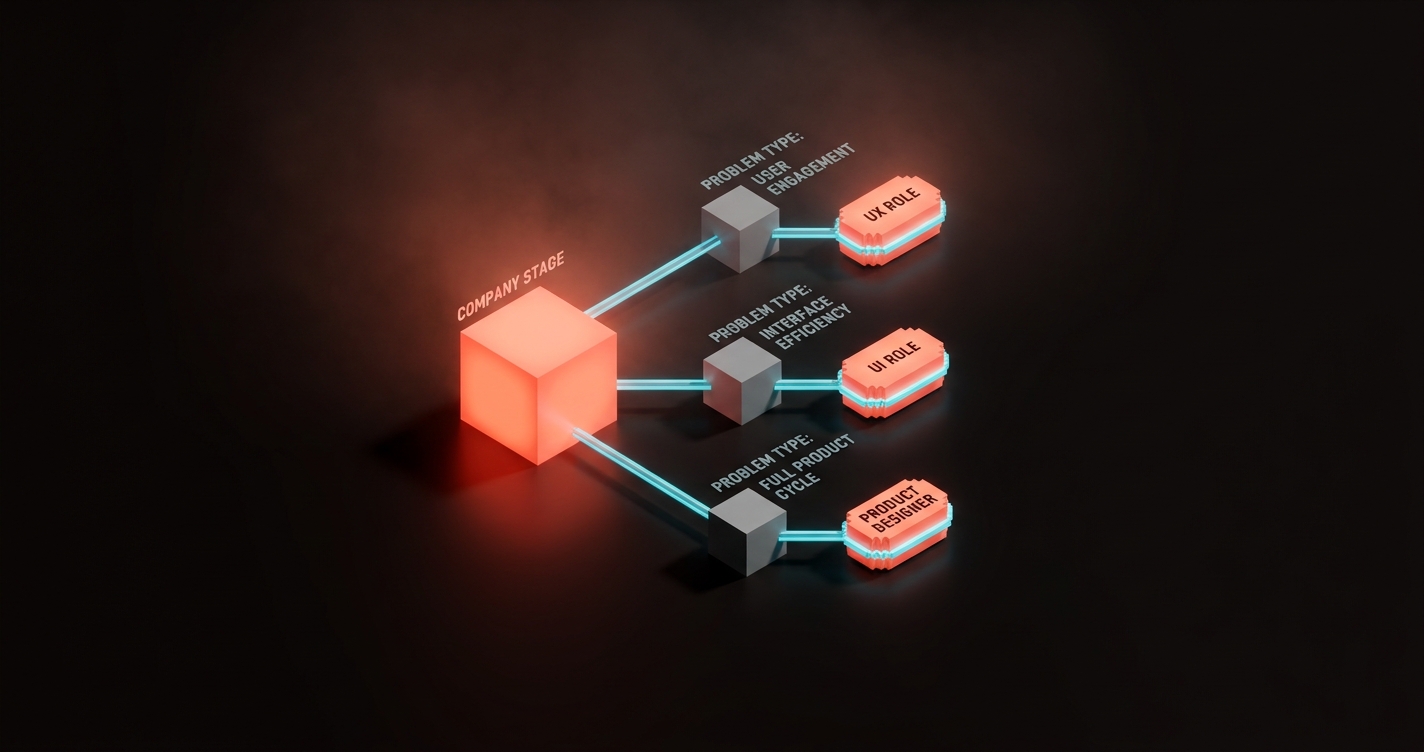
Use the table. Map your situation to a row, hire the role in the last column.
| Stage | Core problem | Team today | Hire |
|---|---|---|---|
| Pre-launch, no designer | Everything needs to be decided and built | Just a founder and engineers | Product designer |
| Pre-launch, has a UI contractor | The product looks fine but users get lost | UI contractor, no UX | UX designer (full-time or senior freelance) |
| Early revenue, scaling | Flows work but the product looks dated and inconsistent | 1 UX / product designer | UI designer or design systems lead |
| Scaling, high user volume | Drop-off in specific flows, unclear why | 1 product designer, stretched | UX researcher (specialist), not another generalist |
| Mature, multi-product | Consistency issues across products | Multiple product designers | Design systems team + principal UX |
| Agency, client work | Need to ship full projects end-to-end | Small team | Product designers + one UX researcher shared |
Three shortcuts that save most founders from misfires:
- If your product has a UX problem dressed as a UI problem, hiring a UI designer makes it worse. They will give you a beautiful version of a confusing product. The confusion will be more expensive to fix because now it looks intentional.
- If you have one design seat, hire a product designer. Specialists only make sense once you have the volume to keep them fully loaded.
- If you are debating "do we need a UX designer or a UI designer," you probably need a product designer and a clearer product brief.
FAQ
Is UI or UX more important?
Neither. A product with great UX and bad UI loses to its competitor on perceived quality. A product with great UI and bad UX loses on actual use. They are two halves of one job, and shipping only one is shipping half a product.
Can one person do both UI and UX?
Yes, and that person is usually called a product designer. Most early-stage startups are better served by one strong generalist than a junior UI/UX split. The specialization only pays off once the team scales past one designer.
Do UX designers need to code?
No, but understanding how things get built makes them better. A UX designer who knows what's cheap, expensive, or impossible in code ships flows that engineering can actually deliver. That's not a coding job. It's a systems-literacy job.
What's the salary difference between UI and UX designers?
In most markets the two titles pay similarly at the same seniority level. Product designer titles tend to pay more than either specialist title at the same level because the role demands both skill sets. The bigger driver of pay is company stage and industry, not UI vs UX.
Hire the role that fits the problem
Stop asking what the difference between UI and UX is. Start asking which specific problem you are trying to solve and which deliverables get you there.
UX ships plans that survived contact with real users. UI ships screens that feel like one product across fifty surfaces. Product designers ship both, end to end, for one product area. Pick the role that matches the problem you actually have, not the title that sounds the most expensive on an org chart.
Every mediocre explainer on the internet will keep recycling the ketchup bottle. You don't have to. You have a product to ship and a team to build for it.
Need to figure out whether your product needs a UI designer, a UX designer, or both? Brainy builds the team for the problem, then ships the work.
Get StartedGet new papers by email
New Brainy papers in your inbox. Confirm once, unsubscribe anytime.