
Claude Fable 5: Launch Data, Benchmarks, and Real Reactions
Claude Fable 5 launched June 9 as Anthropic's first Mythos-class model. The verified benchmarks, the real pricing, and what builders hit in week one.

Claude Fable 5: Launch Data, Benchmarks, and Real Reactions
Fable 5 is the most capable model Anthropic has shipped to the general public. The third-party benchmarks back that up. The catch is not the model: it is the safeguard layer on top of it, and a June 22 subscription deadline most coverage buried.
Here is everything confirmed as of June 10, one day after launch, sourced by name.
What Claude Fable 5 actually is
Fable 5 is Anthropic's first Mythos-class model made available for general use. Mythos-class sits above Opus in Anthropic's capability hierarchy, with Anthropic's own footnote describing it as "a tier of Claude models that sit above our Opus class in capability." Fable 5 is the public, policy-hardened version of that tier.
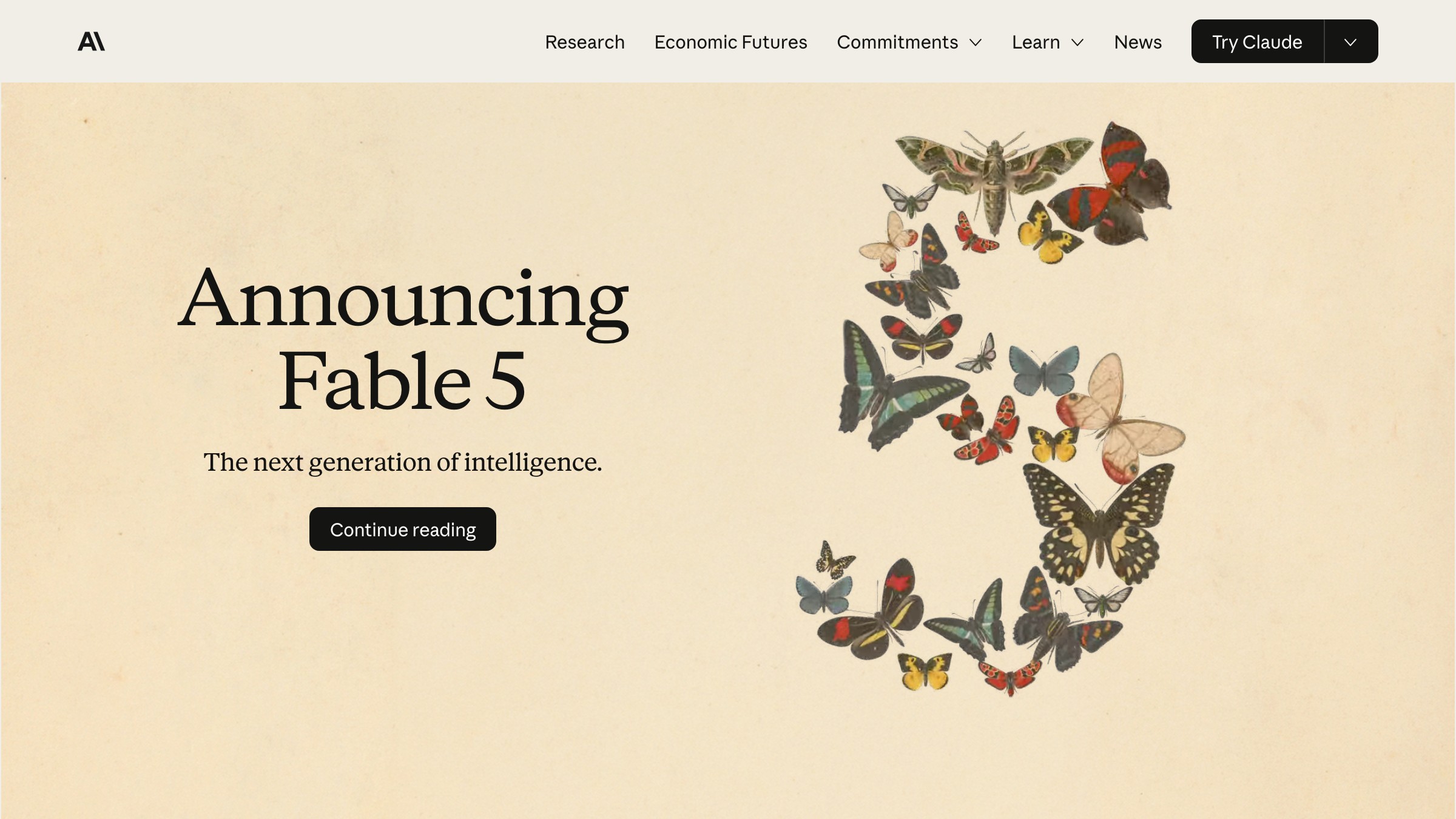
See the announcement on anthropic.com
Claude Mythos 5 is the same underlying model with certain safeguards lifted in specific research areas. It is in limited release via Project Glasswing, starting with cyber security partners and expanding to select biology researchers. It is not a benchmark framework or a separate architecture. It is Fable 5 with fewer guardrails.
Anthropic's framing for the capability gap: "The longer and more complex the task, the larger Fable 5's lead over our other models." That is the signal worth reading carefully.
The benchmark data, verified
Independent third parties confirmed the headline coding claims within 24 hours. Every row below has a named source.
| Benchmark | Fable 5 | Opus 4.8 | Comparison |
|---|---|---|---|
| SWE-Bench Pro | 80.3% | 69.2% | GPT-5.5 at 58.6%, Gemini 3.1 Pro at 54.2% (The Decoder, from Anthropic charts) |
| FrontierCode Diamond | 29.3% | 13.4% prior gen | #1 on FrontierCode "even at medium effort" (Cognition) |
| CursorBench | 72.9% | n/a | 8 points above previous best (Cursor) |
| Terminal-Bench 2.1 | 88.0% | n/a | 4.6 points above GPT-5.5 (Cline) |
| AI Intelligence Index | 65 | n/a | Ranked #1, ~60 tok/s median, $8.20 blended price (Artificial Analysis) |
| Hebbia Finance Benchmark | Highest of any model | n/a | Anthropic announcement |
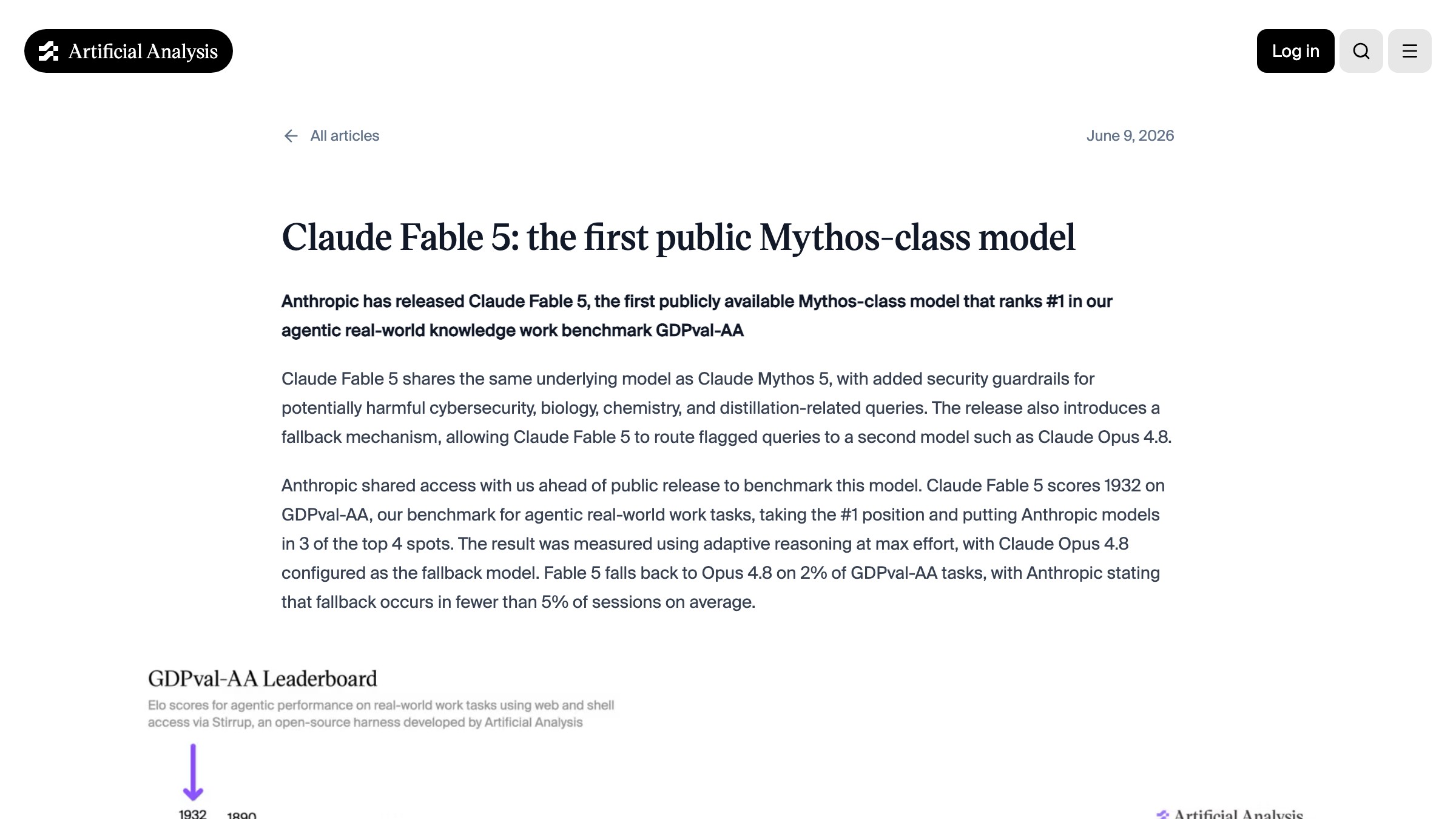
Read the full ranking on artificialanalysis.ai
The Stripe case study is the sharpest real-world signal. In a 50-million-line Ruby codebase, Fable 5 completed a codebase-wide migration in one day that Anthropic says would have taken a human team over two months.
Still missing as of June 10, so treat these as unconfirmed:
- LMArena: registered, no public Elo score yet
- Aider leaderboard: no entry
- ARC-AGI: no entry
- Community SWE-bench replication: still incoming
Pricing and the June 22 catch
| Axis | Fable 5 | Opus 4.8 | Sonnet 4.6 |
|---|---|---|---|
| Input price per MTok | $10 | $5 | $3 |
| Output price per MTok | $50 | $25 | $15 |
| Context window | 1M tokens | 1M tokens | 1M tokens |
| Max output tokens | 128K | 128K | 64K |
| Thinking mode | Adaptive, always on | Adaptive | Extended + adaptive |
API pricing is straightforward, exactly double Opus 4.8. Anthropic notes it is "less than half the price of Claude Mythos Preview," the earlier limited release.
For subscription users, Claude Code's own picker says Fable 5 "uses your limits ~2x faster than Opus."
The window: Fable 5 is included on Pro, Max, Team, and Enterprise from launch through June 22 at no extra charge. From June 23, it requires usage credits on those plans. API access is unaffected.
Simon Willison tested all five effort levels on day one using his pelican SVG benchmark, and the spread is instructive:
- Low effort: 9.67 cents per run
- Max effort: 72.175 cents per run
- His running mid-day total: $82.92 in API-priced tokens, all still covered by his Max subscription
If you want to see how effort levels map to spend before committing, his post and the effort levels breakdown are the fastest path.
What the internet actually thinks
The HN launch thread crossed 2,100 points and 1,650 comments within its first day. That is among the largest model-launch threads in recent memory.
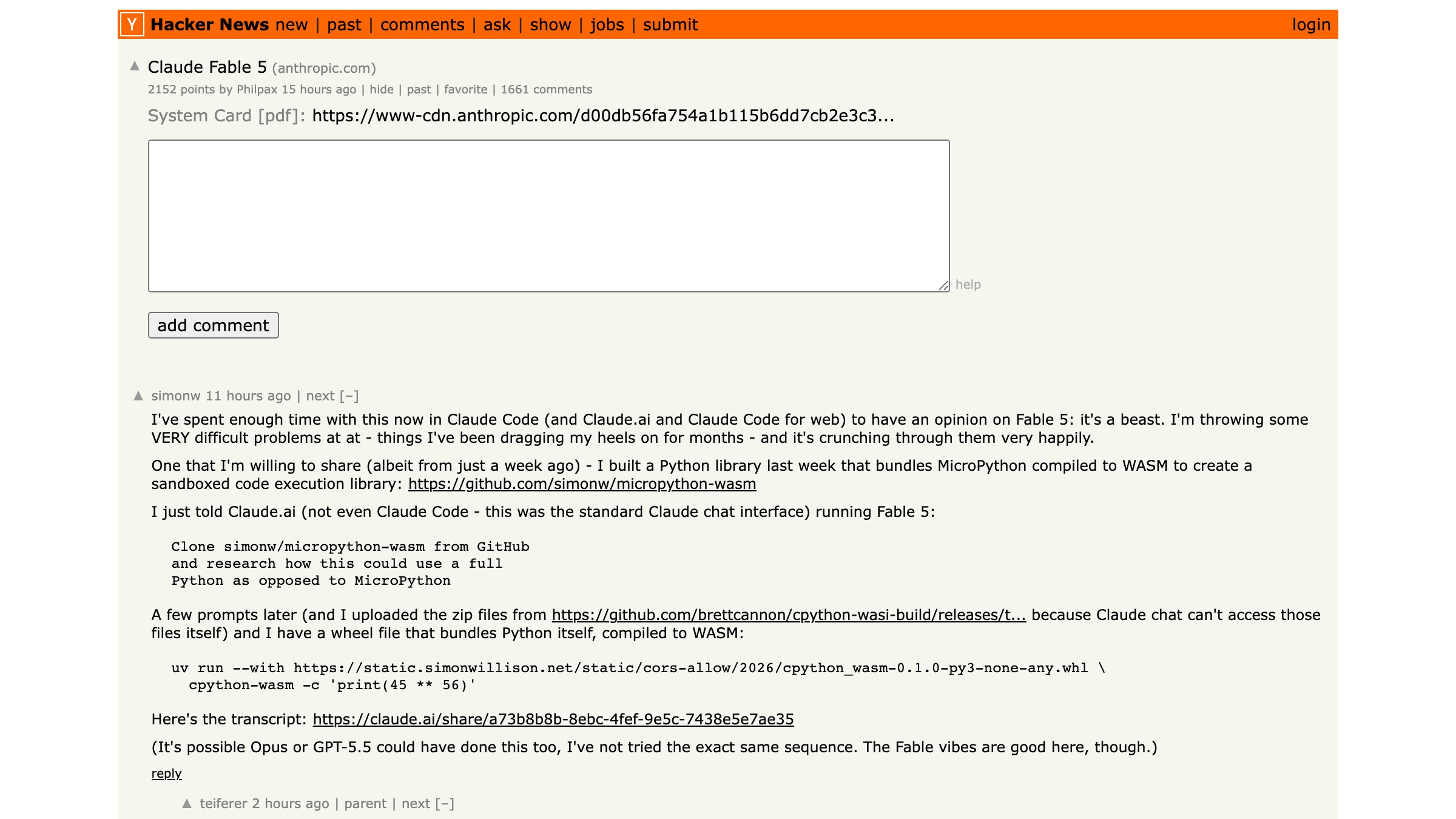
Read the full thread on news.ycombinator.com
The most-cited voices, in order of reach:
- Andrej Karpathy (20,400 likes, 1.7M views): "a major-version-bump-deserving step change forward." He added that you can give it more ambitious tasks and "the model 'gets it' and it will just go." He also flagged: "the safeguards are configured to be a little too trigger happy for launch."
- artursapek (HN): "Fable 5 beats GPT 5.5 in my proofreading benchmark. And it does so at approximately the same total cost."
- Simon Willison (HN): Called the model "a beast" in the thread, saying he was throwing problems at it he had "been dragging my heels on for months."
- Reddit ("Claude Fable 5 feels less like a model launch and more like a preview of AI inequality"): Criticism organized around the June 22 deadline as a hard access divide.
The official launch video hit 371K views in roughly its first 12 hours, with the top creator breakdowns pulling 73K, 66K, and 48K views in the same window.
The safeguard tax
The classifiers are the launch's real catch, and most coverage skipped them. When one fires, the API returns HTTP 200 with a refusal stop reason and silently falls back to Opus 4.8.
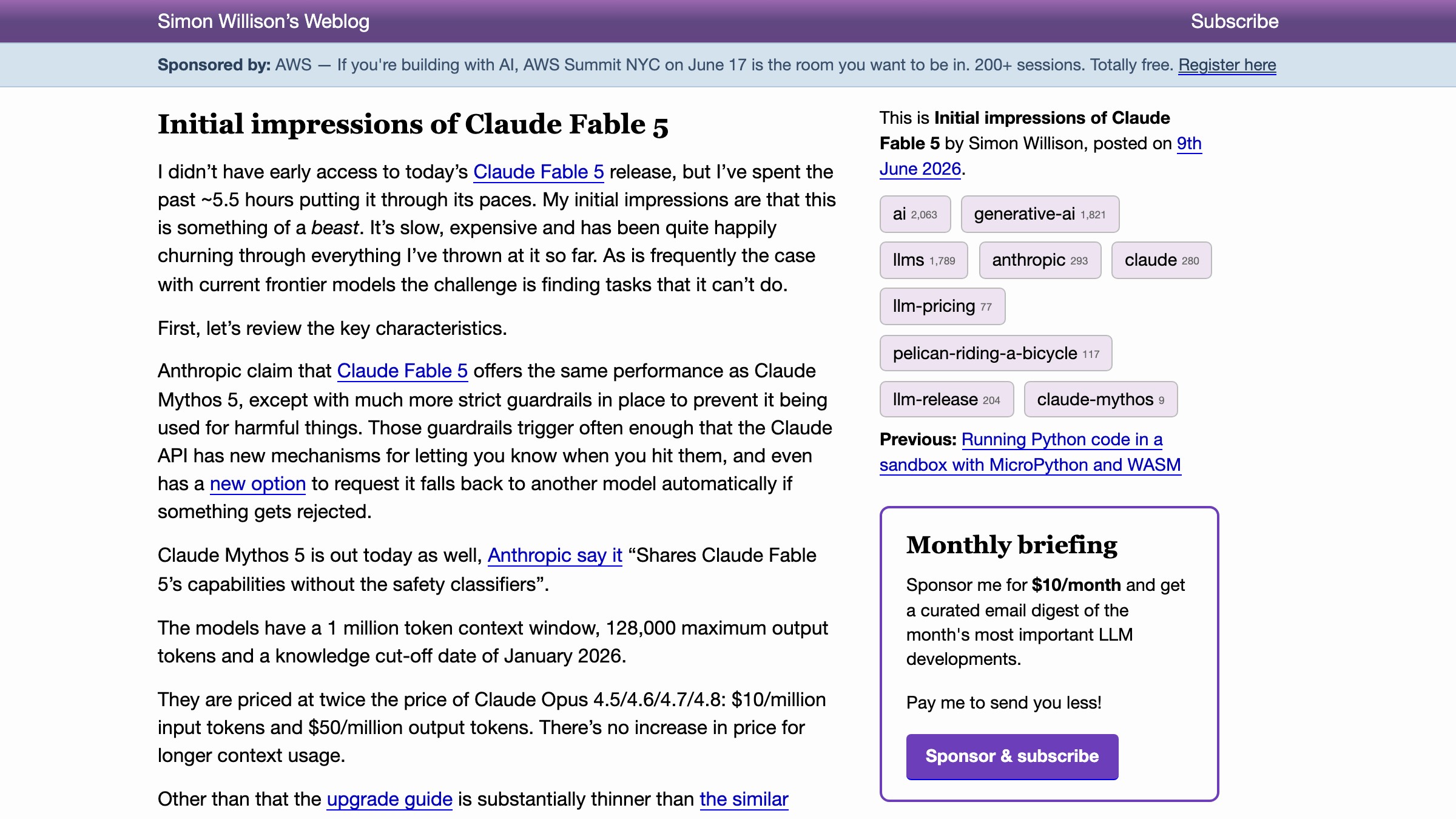
Read Simon Willison's first impressions on simonwillison.net
The user may not be told. Anthropic says this happens in under 5% of sessions, but the day-one cases that surfaced are instructive.
Day-one cases from the thread:
- matheusmoreira (HN): A Lisp code review interrupted mid-session by a classifier flag and an unannounced switch to Opus 4.8.
- arkwin (HN): A vetted Cyber Verification Program member doing legitimate vulnerability research hitting policy violation errors.
- Elie Bakouch (Hugging Face, 1.79M views): Criticized Anthropic for making the model deliberately worse at "frontier llm research" tasks, and for keeping that intervention invisible to the user.
Anthropic is open about this being deliberate. Dianne Penn, Anthropic's head of product management for research, told CNBC the team wanted "to be very intentional about building new types of classifiers and new types of safety guardrails in place for this launch."
The classifier scope may tighten post-launch. The policy will not become a bug fix, because it is not a bug.
One separate blocker: Fable 5 is a Covered Model with a 30-day data retention requirement. There is no zero-data-retention option. Zed and GitHub Copilot for Business users flagged this immediately as a hard adoption blocker for ZDR-required shops.
What designers should do with Fable 5
Anthropic names vision and long-horizon agentic work as the headline improvements for Fable 5. For designers that means full design-system refactors, multi-file Figma-to-code runs, and agentic sessions that previously fell apart after an hour, the exact workflows covered in Claude Code for design work and agentic design workflows.
Karpathy's practical reframe is the most useful takeaway. Scope up the brief, not the prompt.
Fable 5 is not better at one-liners. It is better at holding a large, complex task in context and actually completing it. If you have been sending components one at a time because you did not trust the model to hold the whole system, now is the time to test the whole system.
Test these before June 22, in order of what will reveal the most:
- A full component library migration in a single session
- A multi-file design token audit with structured output
- A Figma-description-to-code run on a layout with 10 or more components
- Any long agentic workflow that previously stalled at context fill
Compared to what Opus 4.8 changed, Fable 5 extends those same patterns into longer sessions and larger scopes. The ceiling moved. The approach is the same.
FAQ
What is the difference between Claude Fable 5 and Claude Mythos 5?
Same underlying model. Fable 5 has safety classifiers active for general use. Mythos 5 has some of those classifiers lifted for vetted research partners via Project Glasswing, starting with cyber security partners. Mythos 5 is not publicly available.
When did Claude Fable 5 launch?
June 9, 2026. The announcement is at anthropic.com/news/claude-fable-5-mythos-5.
What is the model ID for the API?
claude-fable-5 on the Claude API and Vertex AI. anthropic.claude-fable-5 on Amazon Bedrock.
What is the context window?
1 million tokens by default, with up to 128K output tokens per request. That is the same context as Opus 4.8 and double Sonnet's maximum output.
Is Fable 5 on my Claude subscription right now?
Yes, through June 22 at no extra cost on Pro, Max, Team, and Enterprise. From June 23 it requires usage credits on those plans. API pricing is not affected.
What happens when the classifier fires?
The API returns HTTP 200 with stop_reason "refusal" and switches to Opus 4.8. Anthropic says it happens in fewer than 5% of sessions. The fallback is not always visible to the user.
Does Fable 5 support zero-data-retention?
No. It is a Covered Model with a 30-day data retention requirement. This is a hard blocker for enterprise environments with ZDR requirements.
What is the knowledge cutoff for Fable 5?
Anthropic has not published one for Fable 5 as of June 10.
The model is ready before the rules are
The benchmarks are real, the coding performance is confirmed by multiple independent sources, and the Stripe case study is the most concrete signal of what long-horizon capability actually means in production. This is the best model Anthropic has shipped to the public.
The honest read on the gaps: the classifier behavior is a deliberate policy choice Anthropic is transparent about, the ZDR blocker is structural, and the June 22 window is a real deadline. None of that cancels the capability. All of it shapes when and how you can actually use it.
Test it now, on the workflows that matter, before the subscription window closes. The capability is there. The policy layer is still being calibrated.
Brainy creators get briefs, tools, and an audience of 2M+ designers. If you are already building with models like Fable 5, come build with us.
Get StartedGet new papers by email
New Brainy papers in your inbox. Confirm once, unsubscribe anytime.