
How to Present Brand Identity to Clients Without Getting Destroyed
Most brand presentations die because designers defend a dissertation instead of selling a decision. The structure that holds up in the room, with a copyable outline.
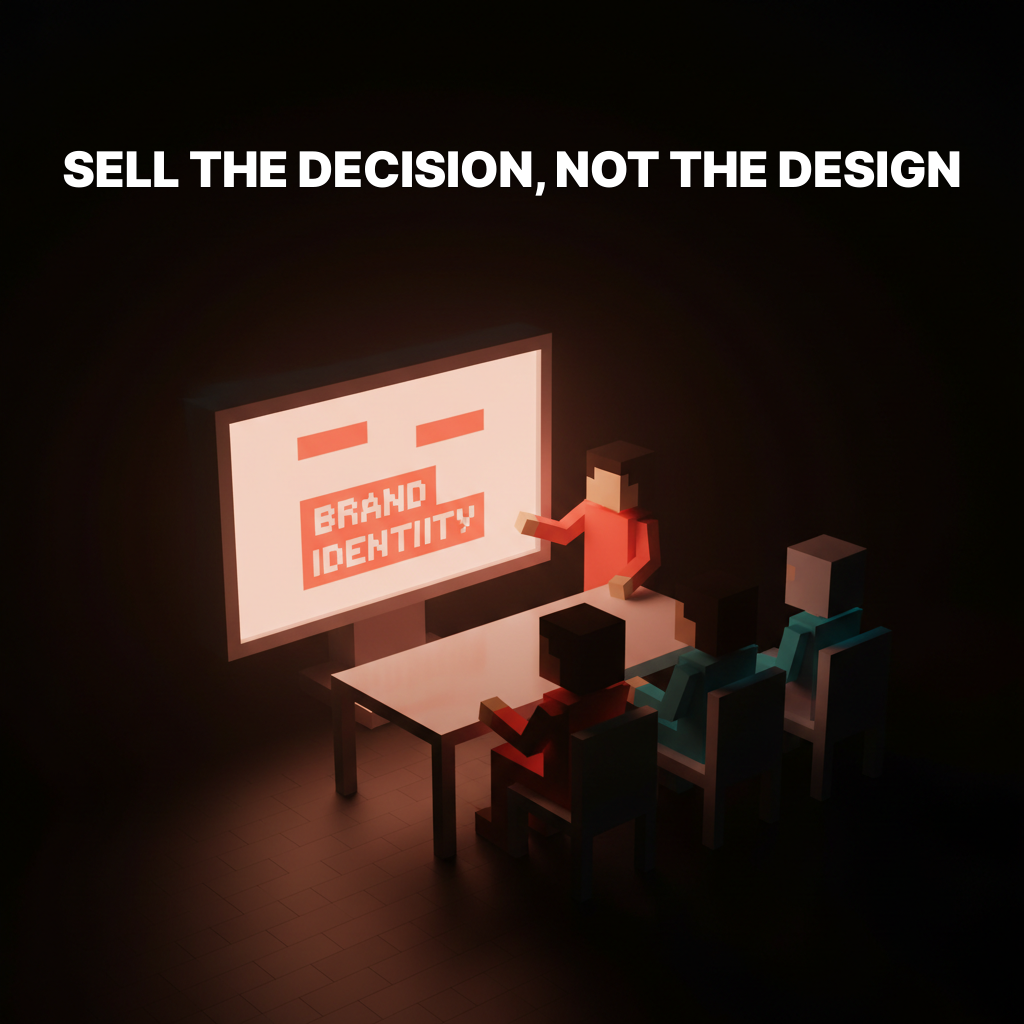
The work was good. The presentation killed it anyway.
Every designer has sat in this meeting. Weeks of strategy, rounds of sketches, a system that actually makes sense, and then 45 minutes into the reveal the marketing director says the green feels "corporate" and the CEO nods, and the whole thing unravels in real time. Nothing changed about the work. The work was right. The presentation was wrong.
A brand presentation is not a reveal. It is a vote you already won in the brief. If you are still selling the concept in the meeting, the brief failed.
Why most brand presentations get destroyed
Designers lose presentations because they walk in to defend a dissertation. The client walks in to make a business decision. Those are two different meetings, held at the same table, and the designer usually loses.
The dissertation format sounds familiar. Fifty slides of process. A history of the brief. A moodboard. Three concepts "for exploration." Ten slides of rationale per concept. A logo reveal moment at slide 38. Then a silence that stretches while the client tries to figure out what they are supposed to do next.
The client does not want three concepts. The client wants one recommendation, framed as a business decision the client already agreed to in the brief. Everything else is noise the room does not know how to hold.
The three reasons presentations die
Almost every brand presentation that collapses, collapses for one of three reasons.
Personal taste. The designer shows work. A stakeholder says "I do not like green." The designer starts defending the green. The meeting is now about taste, not strategy, and taste is a conversation the designer cannot win in a room with a CEO who pays the invoice.
Scope creep in the feedback. The client approved "a brand identity" in the brief. In the meeting, they start asking about the website, the packaging, the out-of-home campaign, and the animated logo version. The designer answers each question and the room drifts from approval to wishlist. When the meeting ends, nothing was approved and the scope doubled.
Rationale overload. The designer over-explains every choice. Thirty slides of "we considered this, then this, then this, here is why we chose this." The client stops tracking around slide eight and then picks at the one decision they remember, which is usually the least defensible one.
The fix to all three is the same. Frame every creative choice as a business decision the client already agreed to, and run a structure that does not give taste, scope creep, or rationale overload a place to live.

The pre-work that prevents most rejections
The meeting is not where you win approval. The brief is. Roughly 80% of presentation disasters are traceable to missing pre-work, not bad design.
Three pieces of pre-work prevent most of the damage.
An aligned brief. Before you design anything, the client has signed off in writing on the audience, the positioning, the three brand principles, and the one sentence that describes what the brand is for. If the client rejects the work later for reasons that contradict the brief, you point at the brief. This is exactly the output of the seven-phase brand identity framework running correctly.
A stakeholder map. You know who is in the room, what each person cares about, who has veto power, and who has influence. The CEO wants growth. The marketing director wants to not get blamed. The founder wants the brand to look like them. You prepare the presentation to land for each of them, not just for the one who signed the contract.
Locked approval criteria. Before the presentation, the client has answered one question in writing: "What does it take for you to approve this?" If the answer is vague ("we need to feel it"), you do not schedule the presentation yet. You schedule another brief session first. A presentation booked on vague criteria is a presentation already lost.
If these three pieces are in place, the meeting becomes a confirmation instead of a negotiation. If they are not in place, no presentation skill in the world will save it.
The presentation structure that actually holds
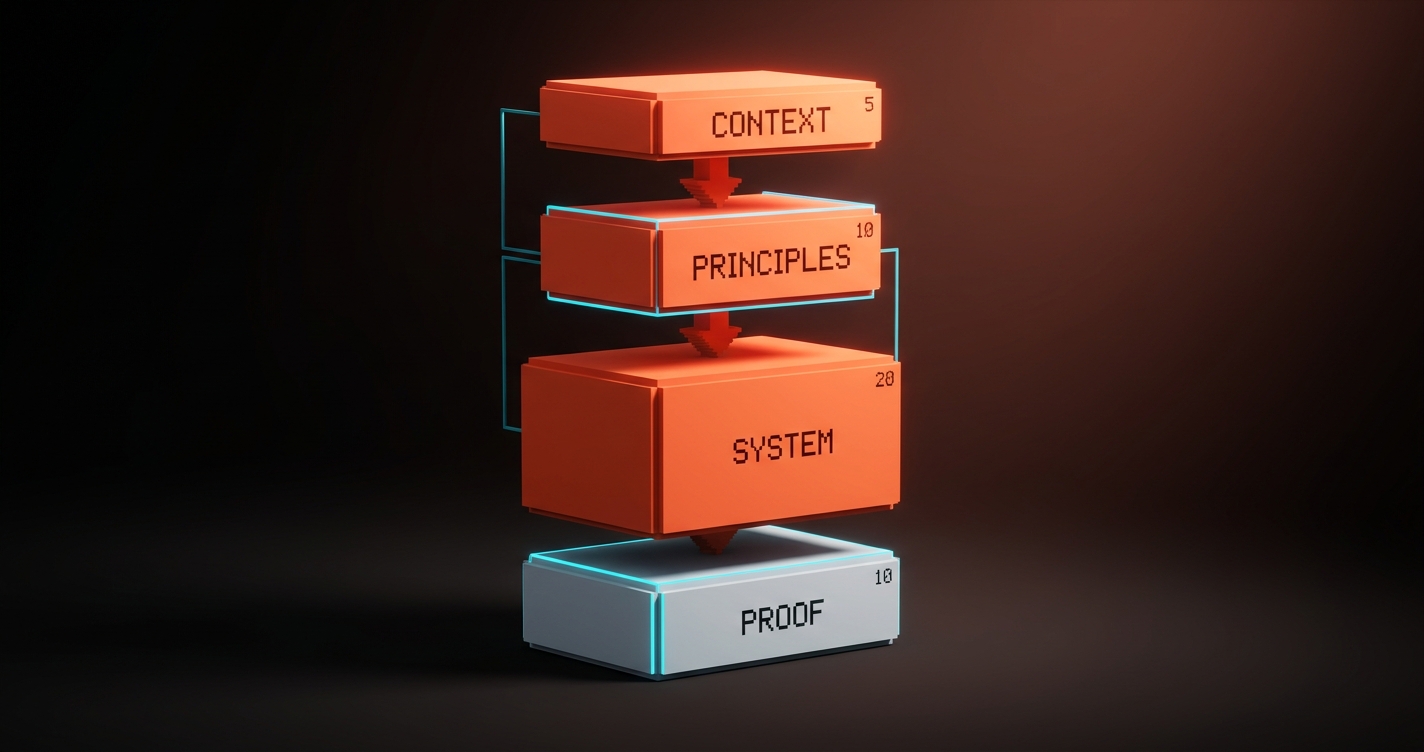
The dissertation format dies because it has no spine. The structure that holds is four parts, in order, with fixed proportions. Context, principles, system, proof. You do not reorder. You do not skip. You do not let the client jump.
Context (5 minutes). You restate the brief. The business goal, the audience, the positioning, the three principles. You are not selling the brief. You signed it already. You are reminding the room what the decision is about before any visual shows up. This takes taste off the table before taste gets a vote.
Principles (10 minutes). You walk through the three brand principles the client already approved, and you show how each one translates into a visual rule. "Principle one: precision. Visual rule: geometric letterforms, tight optical spacing, no hand-drawn marks." The client is now agreeing to visual rules in principle before seeing any mark.
System (20 minutes). You present one direction. Not three. The system, assembled. Logo in context, typography in context, color system in context, a motif in context, voice samples, one or two real applications. You are showing the brand as it will live, not the logo as a trophy.
Proof (10 minutes). You show the work applied. The landing page hero. A social post. A product screen. A business card or digital equivalent. Not as a "reveal." As evidence the system works where the business actually sells. This is the closer.
The copyable outline with timings
Steal this. Paste it into your next presentation deck. Edit the specifics, keep the structure.
Slide 1. Title. Project name, client logo, date. One sentence of the engagement scope.
Slide 2 to 4. Context (5 min). One slide on the business goal, one on the audience, one on the positioning and three principles. Read verbatim from the signed brief. Do not paraphrase.
Slide 5 to 8. Principles (10 min). One slide per principle. Each slide: the principle, the visual rule it implies, one reference of a brand that does this well. No Brainy work yet.
Slide 9. The direction. One sentence. "Based on the brief and the principles, we are presenting one direction today. It is called [name]. Here is what it does for the business."
Slide 10 to 18. System (20 min). Logo system, typography, color, motif, voice examples, two or three real applications. One decision per slide. Each slide headline is the decision, not the feature. "The wordmark is geometric because precision is a principle," not "Wordmark exploration."
Slide 19 to 22. Proof (10 min). Hero landing page, one social post, one product surface, one physical or environmental asset. Each one annotated: "This is what the system does on [surface]."
Slide 23. The decision. One slide. "We recommend approving this direction today. Next steps are [rollout], scoped and priced in the proposal." You ask for approval out loud. You do not wait for the client to volunteer it.
Slide 24. Q and A. A deliberate stop. Not "any feedback?" Ask: "What questions do you have about the recommendation?"
Total runtime: 45 minutes presenting, 15 minutes of structured Q and A. One hour total. Do not book two.
How to handle live feedback without caving
Live feedback is where most designers lose the work they already won. The fix is a small set of scripts, run consistently.
When a stakeholder says "I do not like the green." Do not defend the green. Respond: "That is a taste reaction. Let me walk back through why green is the system choice, so we are reacting to the same thing. [Point to the principle.] If the principle holds, the color holds. If the principle is wrong, we go back to the brief." You moved the conversation from taste to strategy in one move.
When a stakeholder says "Can we also see it in blue?" Do not say yes. Do not say no. Respond: "We explored other directions in the system phase and landed here for these reasons. [Point to the principles.] If you want to explore an alternate direction, that is a second round, scoped separately. Do you want to approve this direction today or schedule that work?" You named the tradeoff. The client now chooses the decision instead of the wishlist.
When a stakeholder says "My [spouse/friend/cofounder] doesn't love it." Respond once, calmly: "Feedback from people who were not in the brief is valuable but it is not decisive. The brand is built for the audience we defined. If you want to run it past another stakeholder, we can add a 30-minute session with them before we finalize. Would that be useful?" You respected the objection without letting it override the brief.
When a stakeholder says "Just give us both options and we will pick." Respond: "We do not present two directions because we do not want you picking based on taste. The brief supports one direction. We recommend this one. If you want the other to exist, that is a new engagement." You protected the recommendation without being difficult.
The pattern under all four scripts is the same. Answer from the brief, not from the design. The brief is the authority you already won.
When a presentation goes sideways
Sometimes it goes sideways anyway. The CEO hates it. The marketing director has a list. The meeting runs long. Here is what to do.
First, do not defend in the room. Say, clearly: "This is valuable feedback. I want to make sure we capture it accurately and respond to it properly. Can we end the presentation here and schedule a 30-minute follow-up on Thursday where we address each point?" You are not retreating. You are refusing to redesign in a conference room.
Second, document every piece of feedback in writing within 24 hours. Group the feedback into three buckets: things consistent with the brief, things that contradict the brief, and things outside the brief scope. Send the document to the client before the follow-up.
Third, run the follow-up as a scoped conversation. For each brief-consistent item, confirm you will incorporate it. For each brief-contradicting item, ask whether the brief needs to change (which is a real conversation, not a revision). For each out-of-scope item, quote it as a change order. You are turning a chaotic meeting into a structured decision.
Most "failed" presentations recover within one follow-up if the designer runs this playbook. The ones that do not recover are usually the ones where the brief was not signed off on before design began. That is a pre-work problem, not a presentation problem.
If you need a partner who handles this end-to-end, with brand identity examples that have already survived real rooms, Brainy ships brand identities clients buy. You present it once. They approve it once.
FAQ
How long should a brand identity presentation be?
45 minutes to present, 15 minutes for structured Q and A, one hour total. Any longer and the room loses focus. Any shorter and the context, principles, system, and proof structure cannot breathe. Do not split the presentation across two sessions. Split meetings are where approval goes to die.
Should I present multiple concepts to the client?
No. Present one recommended direction. Multiple concepts invite taste-based picking, which is how approval gets diluted and why clients end up with Frankenstein brands. If your brief is tight enough, one direction is the correct output. If you genuinely cannot land on one, the brief is not done yet.
How do I handle a client who wants to redesign during the presentation?
Do not redesign in the room. Capture the feedback, end the presentation at the recommendation, and schedule a 30-minute follow-up after you have documented the feedback in writing. Redesigning live is how scope explodes and how you lose your authority in the room. The follow-up is where real decisions happen.
What do I do if the CEO rejects the direction outright?
Ask one question: "Which part of the brief do you feel this direction does not deliver on?" If they point to something specific, that is a real conversation about the work. If they cannot, the rejection is taste, and the answer is "We ran this direction against the principles we agreed on. I would like to walk through that once more before we decide to start over." Then run the principles slides again. Most "outright rejections" become revisions once the brief is back in the room.
The presentation is the last place to sell the work
The designers who get brand identities approved on the first presentation are not the most talented in the room. They are the ones who did the pre-work, built a presentation with a spine, stayed on the recommendation, and refused to redesign during feedback.
A brand presentation is not a reveal. It is a vote you already won in the brief. The work happens in discovery, in the signed brief, in the stakeholder map, and in the approval criteria locked before any pixel is drawn. By the time you are standing in front of the screen, the decision is already made. You are confirming it, not selling it.
Run the four-part structure. Read the brief verbatim. Present one direction. Frame every choice as a business decision the client already agreed to. Handle feedback from the brief, not from the design. Refuse to redesign in the room.
Then ask for approval out loud. The room will give it to you, because the vote already happened.
Need a brand partner who presents work that actually gets approved? Brainy ships brand identities clients buy.
Get StartedGet new papers by email
New Brainy papers in your inbox. Confirm once, unsubscribe anytime.