
How to Write a Design Brief That Actually Ships
Most design briefs are theater. The brief that ships answers six questions, has a one-page constraints sheet, and ends with kill criteria.

How to Write a Design Brief That Actually Ships
Most design briefs are theater. They describe the dream, list adjectives like "modern" and "human-first", and end with a vibe board the client signed to look supportive. Then the project drifts.
The brief that ships answers six questions, fits on one page of constraints, and ends with kill criteria written before the work starts. Everything else is decoration.
Most design briefs are theater
A traditional design brief reads like a wedding speech. Full of feeling, light on decisions, signed by people too polite to push back.
The deck has 30 slides and the mood board has 40 images. Nowhere does it say who decides the work is done, what number ends the relationship, or what the project is not.
That is not a brief, it is a wish list with a cover page. It dies in week six when the client asks for "one more round" and the agency has no document to end the conversation.
A real brief is short, decided, and uncomfortable. If reading it out loud does not make someone shift in their seat, it has not done its job.
The six questions every design brief must answer
Every brief, every project, every engagement. If a brief cannot answer them, the project is not ready.

| # | Question | What it forces |
|---|---|---|
| 1 | Who decides the work is done | A single named approver, not a committee |
| 2 | What does "done" actually look like | A specific artifact, link, or shipped surface |
| 3 | What is explicitly out of scope | A written list of things the project will not do |
| 4 | What budget number kills the project | A real currency figure, not a range |
| 5 | What timeline kills the project | A real calendar date, not a quarter |
| 6 | What is the one metric that matters | A measurable outcome, not a feeling |
Skip any one and the project will get defended in your inbox three months later.
Decider, done, and the line around scope
The first three questions decide who owns the work and what it is. Vague answers here poison the rest.
1. Who decides the work is done
One name. Not "the leadership team", not "we will know it when we see it", not "the founder will weigh in at the end".
A single approver who can say yes, say no, and whose yes is binding. If they need to consult others first, the brief lists those names too, but the approver still signs. Committees do not approve design, they negotiate it into mush.
Name the decider in the first paragraph. If the client cannot, the project is not ready to start.
2. What does "done" actually look like
Not "a polished website". Not "a brand that resonates". An artifact you could screenshot and a link you could hand to a stranger.
For a marketing site, done is a deployed URL with a defined page count, component library, and Core Web Vitals threshold. For a brand identity, it is an asset folder with logo set, type system, color tokens, and a one-page usage doc. Specific. Photographable. Closeable.
If the team cannot describe the final deliverable in one sentence, the brief is still mood-board mode.
3. What is explicitly out of scope
The most powerful section of any brief is the list of things the project will not do.
Every project has invisible adjacent work that migrates inside the scope when nobody is watching. The brief that ships stamps it OUT, with lines like "no extra localizations, no CRM integration, no second round of brand exploration after week four."
Out-of-scope items are protections, not refusals. You don't need a design system is the same discipline at the system level, and designers are PMs now is why scope policing lives in the brief.
Money and time, written in numbers
The next two questions turn vibes into figures.
4. What budget number kills the project
A specific currency figure. Not "tight", not "competitive", not "flexible". A number that, if exceeded, ends the engagement.
Two numbers, actually. The figure the project is sold against, and the figure that triggers a stop. The kill number is usually 15 to 25 percent above the sold number, so the team absorbs honest mistakes without hiding overruns.
Write the kill number in the brief, signed. The pricing page problem covers the same discipline on a public surface; value-based pricing is the deeper read.
5. What timeline kills the project
A real calendar date. Not "Q3", not "by end of summer", not "before launch". A day that, if missed, ends the engagement or triggers a renegotiation.
Two dates again. Ship date and kill date. Nobody wants to write the kill date because writing it makes it real. Write it anyway.
If tied to a launch or fundraise, tie the kill date to it. Anthropic's eval-gated releases and Linear's six-week cycles imply briefs where someone wrote a date and refused to move it.
The one number that defines success
The final question is the smallest and most contested. It decides everything else.
6. What is the one metric that matters
One. Singular. Not a dashboard. One number, observable from outside the team, that decides if the project succeeded.
For a marketing site, qualified leads per month. For a launch, activated accounts in the first 30 days. For a brand refresh, a measurable shift in inbound deal quality, not "brand awareness".
The temptation is to list five metrics so nothing can fail. Resist it.
The single metric goes in the brief, the contract, and on the wall. The anti-dashboard covers why one number beats twelve hidden behind a dashboard.
The one-page constraints sheet
Six questions, one page. If the answers do not fit on a single sheet, the project is still being negotiated.
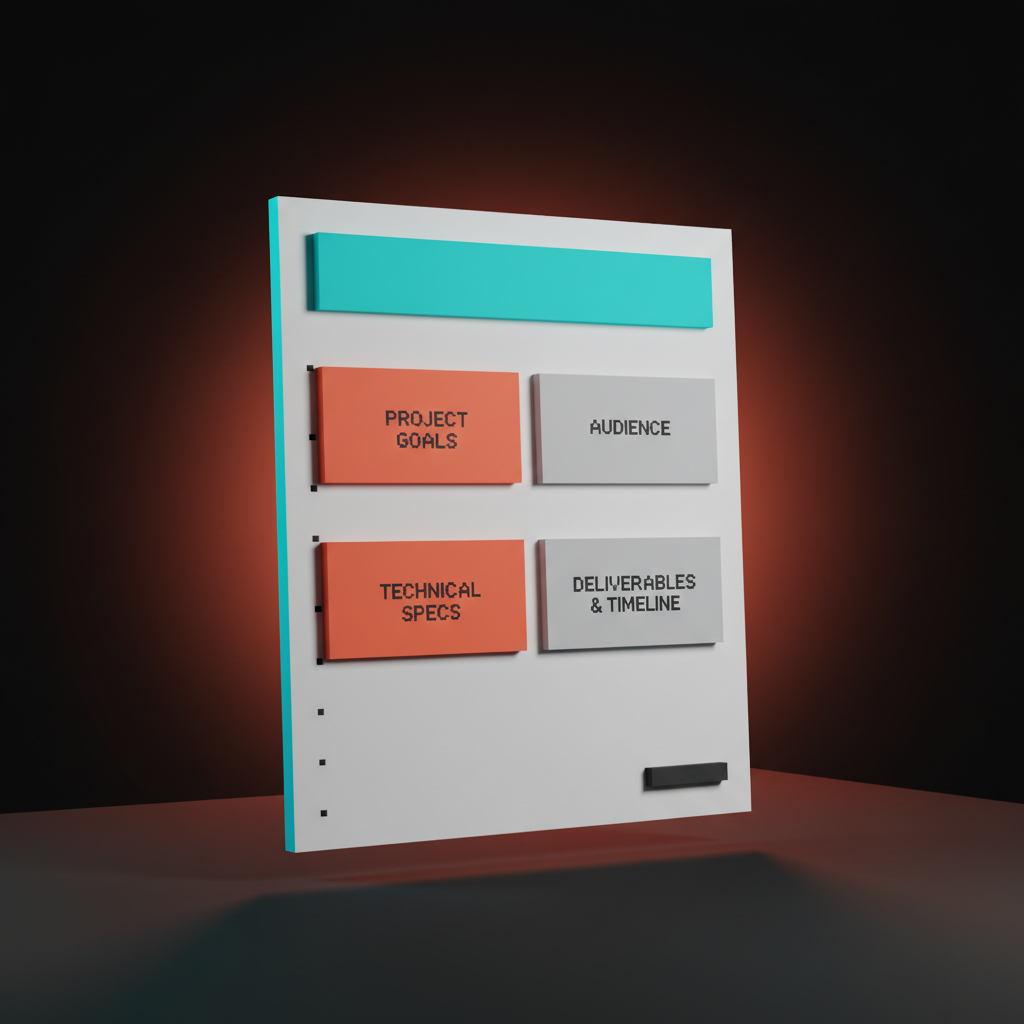
Copy this template, fill it in with the client in the room, and get a signature before scoping the next phase.
ONE-PAGE CONSTRAINTS SHEET

Project: [name]
Client: [company]
Date: [date]

1. DECIDER
   Approver of record: [single name + title]
   Consulted before approval: [up to 3 names]

2. DONE
   Final deliverable: [one sentence]
   Acceptance artifact: [URL, file, or shipped surface]

3. OUT OF SCOPE
   Not included:
   - [item]
   - [item]
   - [item]
   Anything not listed above is also out of scope.

4. BUDGET
   Sold at: [currency + figure]
   Kill at: [currency + figure]

5. TIMELINE
   Ship date: [calendar date]
   Kill date: [calendar date]
   External anchor: [event, launch, or contract trigger]

6. METRIC
   The one number we own: [metric]
   Measured by: [tool or person]
   Reviewed: [date]

Signed: ______________________
        [decider name + date]
The format does not matter, the discipline does. A sheet that fits on a phone screen, read out loud at kickoff, signed by the decider, ships projects. A 30-page brief read by nobody does not.
Kill criteria, written before the work starts
Kill criteria is the part nobody writes because writing it feels like planning to fail. Skipping it is planning to suffer.

Kill criteria are conditions, written on day one, that pause or end the project on purpose. Not "this is going badly", but "this event happened, here is what we do next."
A working set for a typical design engagement:
-
Decider changes mid-project without a written handoff. The new decider re-signs the constraints sheet within five business days, or the project pauses.
-
Budget kill number is reached. Work stops, an honest invoice is sent, and the next phase is rescoped.
-
Timeline kill date is reached without a shipped done condition. Project enters a written renegotiation, not a silent extension.
-
Out-of-scope items added without a change order. A change order is signed within three business days, or the request is dropped.
-
The one metric becomes unmeasurable. If the team cannot measure it for two consecutive review periods, the brief is reopened.
-
Two consecutive milestones missed without a written reason. Project enters a recovery review with the decider before the next milestone starts.
Each criterion has a trigger and a response. The response is never "we will see how everyone feels", it is a written, mechanical action.
The brief does not predict every failure. It commits, in advance, to how the team behaves when failure becomes visible.
How Linear, Stripe, and Vercel briefs read
Nobody outside those companies has read their briefs. The work is the brief in reverse.
Linear ships against six-week cycles with one accountable owner, tight scope, and a shipped surface. Stripe ships docs the day a feature ships, which means the docs were briefed alongside the feature. Vercel turns the deploy log into the launch surface, the same posture covered in the loading state is the product.
Reverse-engineer the brief from the work. One decider per surface. Done is shipped, not approved. The out-of-scope list is visible in the features that never shipped.
The lesson is not "write your brief like Linear". It is "look at work you respect and ask what brief would have produced it". The failure mode is in why every SaaS looks the same in 2026.
The brief is a contract, not a wish list

A brief that lives next to the contract is a contract. One that lives in a dusty Notion page is a wish list.
Attach the constraints sheet to the statement of work. Reference the kill criteria in the engagement letter. Make the one metric a clause, not a slide. If a wireframe is the structural contract for a screen, the brief is the same for the engagement.
When the work drifts, and it always does, the brief ends the drift. A page, signed, read at kickoff, pinned to the project channel. That is the difference between a brief and theater.
Run this on Monday morning
The next brief on your desk gets the six-question test before the kickoff call.
Open it. Take a blank page and write the six questions on the left, the brief's answers on the right. If any answer is missing, vague, or written in adjectives instead of artifacts, that is the kickoff agenda. Not "let us walk through the deck", just "we cannot start until these six are answered."
Most clients respect this. The few who do not are the same clients who would have produced the slipped deadline and unpaid final invoice. The brief filters them out before work starts.
FAQ
How long should a design brief be?
One page of constraints, plus whatever supporting context the team needs. The constraints sheet is the contract. If those constraints do not fit on a page, the project is still being negotiated.
What is the difference between a creative brief and a design brief?
A creative brief covers messaging, audience, and tone. A design brief covers all that plus the operational constraints that decide whether the project ships: decider, done, budget kill, timeline kill, out of scope, one metric. A creative brief without a design brief is a vibe document.
Who should write the design brief, the agency or the client?
The agency drafts it, the client edits it, the decider signs it. A brief written entirely by the client is a wish list; one written entirely by the agency is a sales doc. The right brief is co-authored, agency on structure, client on constraints.
CTA
Want a partner who runs the brief like a contract instead of a kickoff slide? Brainy ships against six questions, a one-page constraints sheet, and kill criteria that protect everyone. Hire Brainy and the first thing you see is a brief, signed before a pixel moves.
Want a partner who runs the brief like a contract instead of a kickoff slide? Brainy ships projects against six questions, a one-page constraints sheet, and kill criteria that protect everyone.
Get StartedGet new papers by email
New Brainy papers in your inbox. Confirm once, unsubscribe anytime.