The Personal Software Era: Apps Built for You and Seven Friends
Personal software, bespoke apps built by one person for ten people, is killing mass-market SaaS for niche use cases. Here is what designers should do now.
Software for the masses is a phase, not a permanent state. The last twenty years of mass-market SaaS were a temporary detour caused by distribution being expensive, and that detour is ending in real time.
For the first time since the dawn of computing, one person can write a working app on Sunday for nine specific people and ship it before bedtime. This is not a hobbyist sideshow. It is a structural shift in who builds software, who it is built for, and what design even means.
What personal software actually is
Personal software is software built by one person, often for themselves, sometimes for ten specific people, and almost never for a market. It is bespoke by intent, not by accident. The maker knows every user by name.
Geoffrey Litt has been writing about malleable software for years, the idea that the people using a tool should also be able to reshape it. Linus Lee builds tiny tools for his own thinking. Maggie Appleton coined "barefoot developers" for the wave of non-engineers who can now ship working software because the cost of doing so collapsed.
Put those threads together and you get a category. Software whose target audience is the maker plus a handful of friends, family, or colleagues, and whose value comes from fitting that small group with uncomfortable precision.
Why now, and why not in 2015
Two things changed at once. AI assistants made it economical for one person to build a real app in an afternoon. And distribution costs, hosting, deployment, payments, auth, hit zero or close to it.
In 2015, building a niche app meant six months of nights and weekends, a Stripe integration that took three days, and a deployment story that took a week to harden. The math did not work for anything smaller than a startup. The long tail of use cases was unreachable.
In 2026, the same app is one prompt, one Vercel deploy, and a Convex schema. The minimum economic audience for a piece of software dropped from "tens of thousands" to "you and seven friends." That is not a tooling improvement. That is a category door opening.
The third factor is taste. A generation of designers and tinkerers grew up on software, formed strong opinions about what was wrong with the apps they used every day, and now have the means to fix it for themselves without asking anyone's permission.
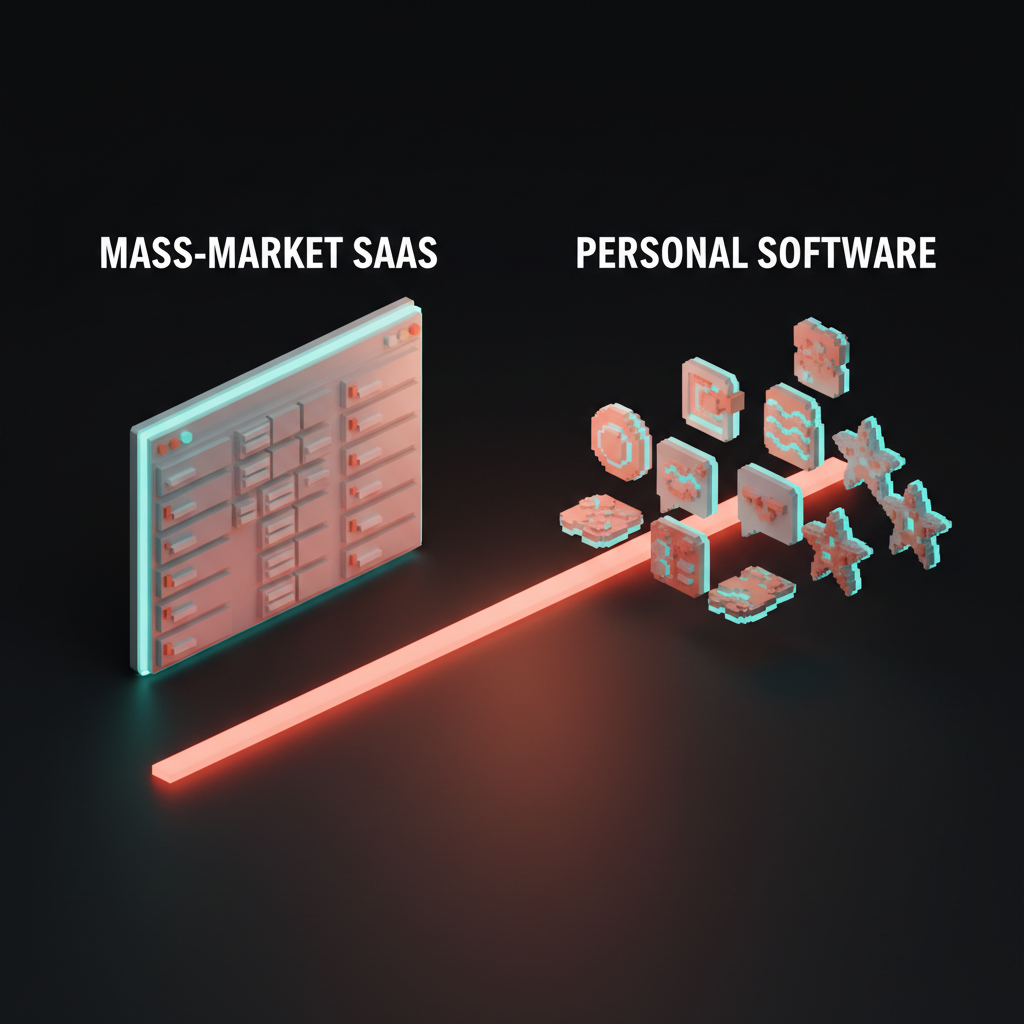
Real examples, not hypotheticals
This is not a thought experiment. Personal software is already running on a lot of laptops.
People run Notion as a private mini-CMS for their household, with views and templates that would make no sense to anyone outside the family. Replit and Lovable side projects ship in an evening, get used by ten coworkers, and quietly handle real work for years. Family schedulers, custom invoice generators, bespoke meal planners like the food-plan-pi style of single-purpose apps, all running for an audience of four to fifteen.
The malleable software movement is producing tools where the user is also the editor. Tana lets people build their own information systems instead of fitting into a template. Capacities does similar work. Obsidian's plugin ecosystem is a whole economy of personal tools shared sideways between people who have similar enough brains.
The pattern: one maker, a small audience, a tight fit. Nothing is being scaled. Nothing is being marketed. The software just exists, for the people it was built for, and that is the entire point.
How it is different from no-code
No-code was templated software. Personal software is bespoke software. The difference is intent.
A no-code tool gives you a Lego set and asks you to build a house that looks like the one in the catalog. The whole point is that thousands of people will build similar houses on the same platform. The economics depend on it.
Personal software starts from a different question. Not "which template fits my need" but "what does my actual situation require, and how do I encode it." The maker is not picking from options. They are describing intent, often in plain English to an AI assistant, and getting code that fits exactly.
This matters because templated tools have a ceiling. Anything that does not fit the template gets bent or dropped, while bespoke tools have no such ceiling. If your accounting needs a column for "amount Kyle gets paid this month at his ten percent flat rate," you just add it. No vendor request, no feature backlog, no waiting.
The long tail finally reaches the bottom
Chris Anderson described the long tail in 2004, but software never really got there. Mass-market SaaS could profitably serve the head and the upper middle of the curve. Everything past that was a wasteland of unmet needs that did not justify a company.
Personal software fills that wasteland. The use cases that were never big enough to support a startup, the niche workflows, the household-specific weirdness, the team-of-six tools, are now the natural habitat of one-person apps.
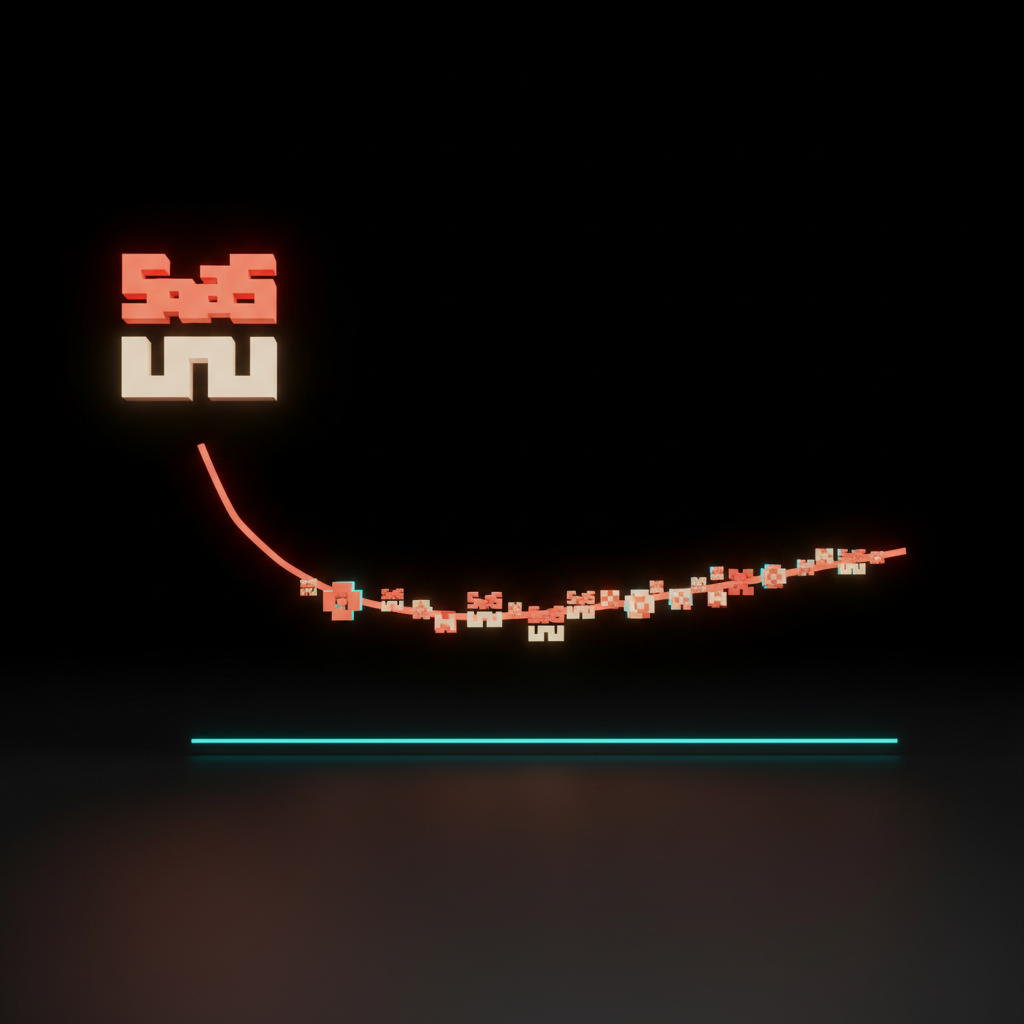
The economics flipped. A use case with eight users was previously unbuildable. It is now trivially buildable. Multiply that across a million micro-niches and you get a software economy that looks nothing like the App Store top charts.
What dies, what survives, what grows
Not all SaaS is going to be eaten by personal software. The shift is uneven, and the winners and losers are predictable if you look at where the value actually sits.
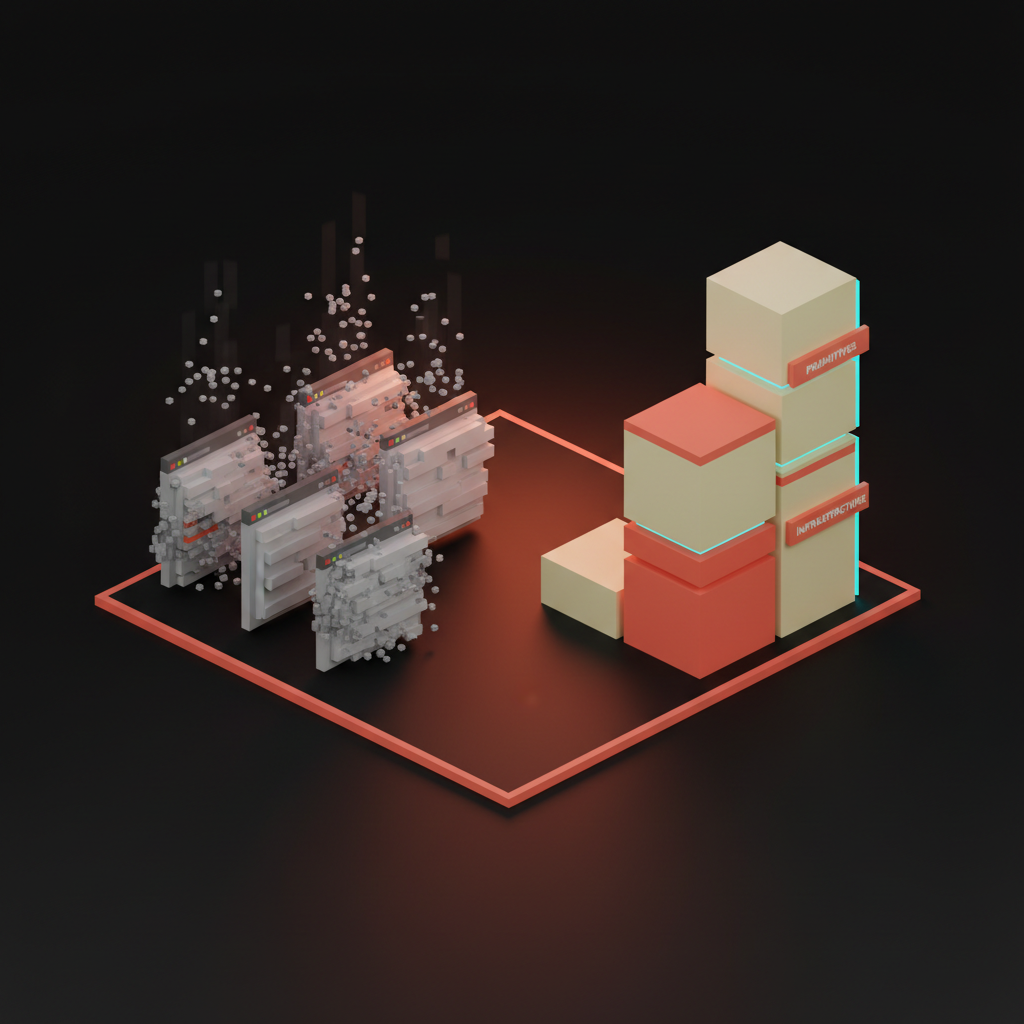
What dies first is mass-market SaaS aimed at niche use cases. The "we are the Notion for dog walkers" tier. Anyone whose product is a thin specialization on top of a generic primitive is now competing against a Sunday afternoon and a prompt. That fight ends one way.
What survives and grows are platforms, primitives, and infrastructure. Convex, Vercel, Supabase, Stripe, Clerk, the AI providers, Replit, Lovable. The picks-and-shovels layer gets bigger as more people build software, not smaller. Same for the design system primitives, the UI libraries, the iconography sets, the auth flows that everyone reuses.
What also survives is true mass-market software where the use case really is universal. Email, calendars, browsers, operating systems, search, the social graphs. Personal software does not replace WhatsApp. It replaces the project management tool a fifteen-person agency was paying eight hundred dollars a month for.
Mass-market SaaS vs personal software, side by side
The shift is easier to see when you put the two models on the same table.
| Dimension | Mass-market SaaS | Personal software |
|---|---|---|
| Target audience | Thousands to millions | One to a few dozen |
| Positioning | "For teams that X" | "For me and seven friends" |
| Distribution | Paid ads, SEO, sales team | Sent in a group chat |
| Pricing | Per-seat monthly subscription | Flat fee, donation, or free among friends |
| Design priority | Onboard a stranger in sixty seconds | Fit a known person perfectly |
| Customization | Settings menu, feature flags | Edit the source, ask the AI to change it |
| Lifespan goal | Indefinite, with constant new features | As long as the use case lasts, then archived |
| Maker incentive | Capture a market | Solve a specific problem |
Notice the design priority row. That is where the role of the designer changes most.
The designer's new job
If you are a designer, the work shifts under you. Mass-market design is about onboarding strangers, reducing friction for the worst case, and never assuming context. Personal software design assumes context, names users, and optimizes for fit, not generality.
The new design work has three core moves. Setting context. Exercising taste. Editing.
Setting context is the work of telling an AI assistant or a small team enough about who this is for that the output fits. Not "design a meal planner" but "design a meal planner for a family of four where one person is vegetarian, the kids hate textures, and the cook has thirty minutes on weeknights." The brief is the design.
Taste is the filter. When code is cheap and prompts are free, the bottleneck is whether the output is good. A designer's job is to know what good looks like for this specific audience and reject everything that does not match. Less drawing, more judging.
Editing is the iteration. Personal software is not handed off to engineers and shipped, it is shaped over time, often live, by the designer who is also the maker or sitting next to the maker. The Figma file is no longer the artifact. The running app is.
How to design for an audience of 10
Designing for ten people is not a smaller version of designing for ten thousand. It is a different discipline. Here are seven principles that hold up.
-
Name every user. Literally, have a list. Know what each person needs, what each person hates, and what each person will tolerate. If you cannot write that document, you are still designing for an abstraction.
-
Skip the onboarding. Your users do not need a tour, they are your friends. Drop them into the app already configured for them. Default to the answer instead of the question.
-
Optimize for the specific, not the average. The average user does not exist when there are ten of them. There is just Aaron, who likes dark mode, and Serina, who needs the keyboard shortcut. Both get what they want.
-
Let it be ugly in the right places. Personal software does not need a marketing site, a pricing page, or a hero illustration. The home screen can be a list, the settings can be a JSON file. Spend taste where it is felt, not where it is expected.
-
Make it editable. Your users are going to want changes. Build in a way that makes those changes easy, even if it means a slightly less polished surface. Malleability beats polish at this scale.
-
Design for one device, not all of them. If your audience uses the app on a laptop, ignore mobile. If they use it on phone, ignore desktop. Universal responsive design is mass-market thinking.
-
Plan for archival, not eternity. This software does not need to last forever. It needs to work for as long as the use case exists. When the use case ends, archive it without ceremony.
The barefoot developer wave
Maggie Appleton's term "barefoot developers" captures something the industry kept missing. The next wave of software builders is not engineers who learned to design. It is designers, writers, researchers, accountants, teachers, and operators who learned to ship.
These people were never going to bootcamp into a six-figure engineering job. They have day jobs and lives and specific problems they want solved. What they have now is the ability to describe what they want in English, get working code back, and run it on a laptop or a free-tier deployment.
This is who personal software is being built by, mostly. Not full-time founders. People with strong domain knowledge, weak engineering chops, and the patience to iterate with an AI assistant until the thing works. The result is software shaped by people who actually understand the problem, which is a category of software the industry has been starved of.
The second-order effect is that the design taste in personal software tends to be sharper than in mass-market SaaS. The maker is not a junior PM with a roadmap to defend, they are the person living with the problem. When they see something ugly or wrong, they fix it the same hour. The feedback loop is so tight that bad design literally cannot survive a weekend.
What changes about software craft
When the audience is small and the maker is close, the craft of software changes. The defaults shift. The trade-offs land in different places.
Reliability becomes more forgiving. If the app breaks for ten people, the maker hears about it in a group chat and patches it. There is no SLA, no on-call rotation, no escalation. This sounds bad until you realize that mass-market SaaS reliability theater is mostly a tax on the user.
Customization becomes the default rather than a feature. Mass-market software treats customization as a settings menu, a list of toggles the maker reluctantly added, while personal software treats it as the core. If you want a column added, the maker adds it, and if you want the colors different, they change. The product does not have a frozen surface that gets renegotiated with a quarterly roadmap.
Documentation looks different. A README for a tool with ten users is a paragraph of context, a screenshot, and the maker's phone number. The thirty-page knowledge base, the in-app tour, the help articles, the chat widget, all of that is overhead the small audience does not need.
Performance choices change. You can ship a slower app for ten users you trust because they will tell you when it gets in the way. You cannot ship a slow app to a million strangers. Personal software gets to skip a lot of premature optimization.
What it means for ethics, portfolios, and pricing
Personal software raises real questions about data ownership, lock-in, and longevity, and the answers are mostly better than what SaaS gave us. Data lives where you put it, often in your own database or a file you control. Lock-in is lower because the maker is right there, not a vendor with reasons to keep you trapped.
Longevity is the harder one. Personal software dies when its maker stops maintaining it, which happens. The honest answer is that this is fine. Most software should not last forever, and the trade for fit and ownership is that you accept the app may live for two years and then go away.
The pricing model shifts because the unit of value shifts. Per-seat monthly subscriptions assume a market. Personal software has clients, not customers, and clients pay differently.
Flat project fees, retainer relationships for ongoing edits, gift economy among friends, bounty-style payments for specific features. The maker is not running a SaaS. They are running a tiny custom shop, or building for free for people they care about. Both are economically viable now.
For designers selling their services, the move is from "design system for a SaaS launch" to "design and build a bespoke tool for a specific team or family." The deliverable is the running app, not the Figma file. The pricing is the value of the problem solved, not the hours billed.
For portfolios, the work is going to look weirder. Less polished marketing sites, more screenshots of weird internal tools that solve real problems for real groups. The case study is not "we redesigned a dashboard for a Series B startup." It is "we built a school-trip-organizing tool for thirty parents and it actually got used."
What designers should do this year
The shift is happening whether you participate or not. Here is what the smart move looks like in 2026.
Start building for yourself. Pick a problem you actually have, in your own life or work, and build the tool using Replit, Lovable, Cursor, or just Claude Code and a Vercel account. The point is not to learn the tools, the point is to feel what it is like to be the entire team for a piece of software.
Start building for ten people you know. After one personal tool, build one for a small group. A family, a club, a team at work. Notice how design decisions change when you know every user by name.
Stop framing your design work around mass-market polish. Reposition. The market is not buying "frictionless onboarding for a mass audience" anymore. It is buying "fit, taste, and the ability to ship the actual thing." Show that in your portfolio.
Pay attention to the malleable software writing. Litt, Lee, Appleton, the Ink and Switch crowd, the small-tool builders on Twitter and Threads. The vocabulary, the patterns, the design language of personal software is being formed in those conversations right now. Get fluent in it.
The personal software era is the most interesting thing to happen to software design in fifteen years. Mass-market SaaS will keep existing in the categories where it makes sense. But the long tail just opened up, and the people who get there first will define what design for an audience of ten even means. Be one of them.
hero:
  key: hero
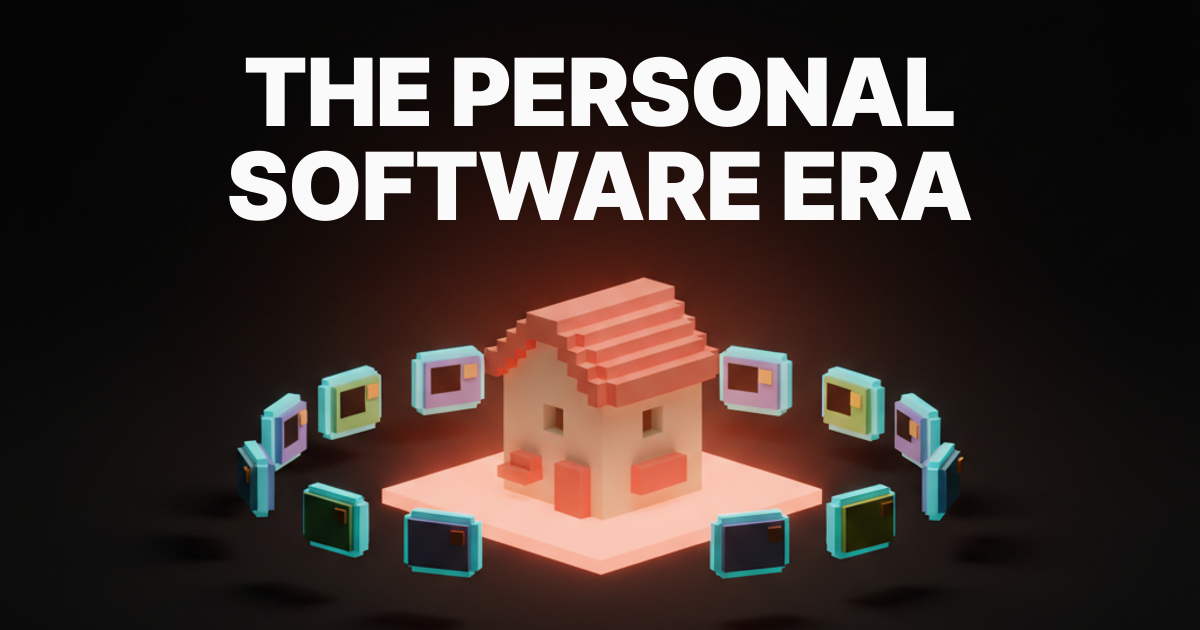
  prompt: "Voxel illustration. A small house-sized app glowing warmly, with 10 little floating screens around it, each tailored to a different person. Soft pastel. Editorial. The composition does not include any human figures."
  alt: "Voxel illustration of a small house-sized app glowing warmly with ten tiny tailored screens floating around it"
  width: 1600
  height: 900

inline-1:
  key: mass-vs-personal
  prompt: "Voxel split illustration: left, a giant generic SaaS dashboard. Right, ten tiny bespoke apps, each warm and specific. Soft pastel. The composition does not include any human figures."
  alt: "Voxel split image showing one giant generic SaaS dashboard on the left and ten tiny bespoke apps on the right"
  width: 1400
  height: 900

inline-2:
  key: distribution-collapse
  prompt: "Voxel illustration showing a long-tail curve labeled 'use cases' with tiny apps populating the previously-empty tail. Soft pastel."
  alt: "Voxel long-tail curve labeled use cases with tiny apps filling the previously empty tail"
  width: 1400
  height: 900

inline-3:
  key: design-for-ten
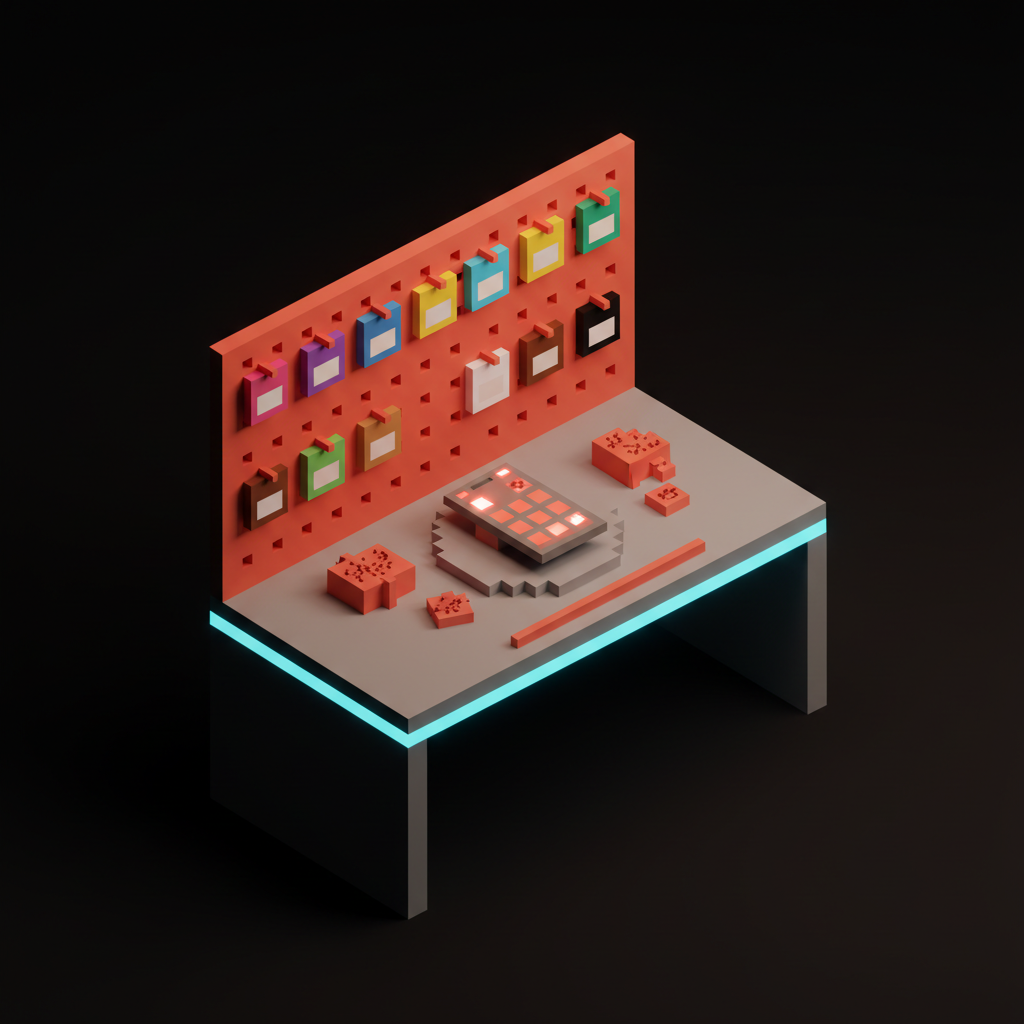
  prompt: "Voxel illustration of a designer's workspace tuned for an audience of 10: name tags on the wall, context notes, an obvious local fit. Soft pastel. The composition does not include any human figures."
  alt: "Voxel designer workspace with name tags and context notes tuned for an audience of ten"
  width: 1400
  height: 900

inline-4:
  key: what-dies-what-survives
  prompt: "Voxel illustration: on one side, generic SaaS dashboards crumbling into mist. On the other, infrastructure platforms growing taller. Soft pastel. The composition does not include any human figures."
  alt: "Voxel illustration of generic SaaS dashboards crumbling on one side and infrastructure platforms growing on the other"
  width: 1400
  height: 900
Want help designing software for ten people instead of ten thousand? Brainy ships personal software with the same craft as our biggest brand work.
Get StartedGet new papers by email
New Brainy papers in your inbox. Confirm once, unsubscribe anytime.